Geographical Perspectives
    • Home
    • Geography
    • Pueblo
    • Teaching
    • About
    • Aftermarket Analytics
    • 12 years ago
    • Geography
    • Real Estate
    • Justin
    • economics
    • housing
    • natural hazards
    • open space
    • prices
    • quality of life
    • real estate
    • Thomas Sowell

    The High Cost of Geographically Illiterate Economists

    Today I read an article written by economist and columnist Thomas Sowell. The piece is entitled “The High Cost of Liberalism“.  The article uses the example of extraordinarily high single family housing prices in Palo Alto, California as an attempt to argue that “liberal” policies don’t work. His thesis seems to be that a desire for allocation of green space is just one of many liberal governing practices that lead to high prices. His implication of course is that “liberalism” is bad not just for real estate prices but for everything else as well. I think it might be time for him to buy a map.

    I love when economists talk about real estate but omit any and all geographical context as if location, at various spatial scales, is irrelevant. Haven’t they heard the “location, location, location” real estate mantra? Here’s what Dr. Sowell says about the abundance of land near Palo Alto:

    “There are people who claim that astronomical housing prices in places like Palo Alto and San Francisco are due to a scarcity of land. But there is enough vacant land (“open space”) on the other side of the 280 Freeway that goes past Palo Alto to build another Palo Alto or two — except for laws and policies that make that impossible.”

    Isn’t it great the way he refers to the land west of the 280 Freeway as “vacant” and “open space”? Just a huge collection of vacant lots with wells ready to pump water and utilities ready to hook up to cookie-cutter housing developments, right? If only those darn liberals would give everyone permission to build legions of condos, all of the SF Bay area would suddenly be affordable.

    In the naive world of neoclassical economists who can’t be bothered with geographical data elements or other real world constraints, he’s correct; the area west of the 280 is sparsely populated. What he glosses over, however, is typical of the army of geographically illiterate economists who seem to feel entitled to dictate policy without actually understanding anything about the physical world.  Trivial details regarding water resources, topography, natural hazards, transportation infrastructure, etc don’t really matter to most economists because they can calculate elasticity of demand and that’s good enough … at least for their fellow economists. If you’re a geographer you have to push well beyond supply and demand and sort through layer after layer of physical and cultural geography to properly understand a region before you divide it up and hand out building permits.
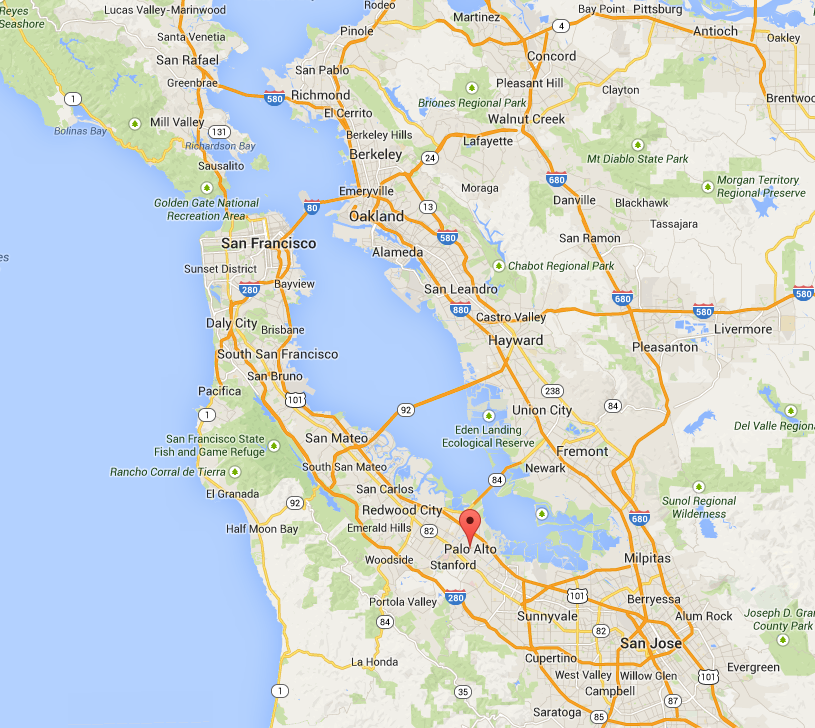
    PaloAltoMap

    The western half of the San Francisco Peninsula has varied topography climbing from sea level on the Pacific Coast up to about 2,500 to 3,500 feet (750-1,000 meters) at some peaks in the northern part of the Santa Cruz Mountains and then back down to near sea level in the heavily populated strip of land next to the San Francisco Bay, known to most people as Silicon Valley. So Dr. Sowell’s prime building area is mountainous. It’s also a biologically diverse area with an equally diverse range of climatic conditions. Most of the area is classified as temperate rainforest but there are areas of dry chaparral and coastal old growth forest, to name a couple. The region is a groovy place to build a cabin tucked in the woods, and I think the Woodside – Portola Valley area  does indeed have low density residential properties that fit the bill (except they’re probably the 3,000 sq ft variety complete with steel appliances, granite counter tops, cherry cabinets and heated tile floors … plus, of course, a heated garage for the Tesla). But the region west of 280 is not setup for “another Palo Alto or two” for a few glaring reasons.
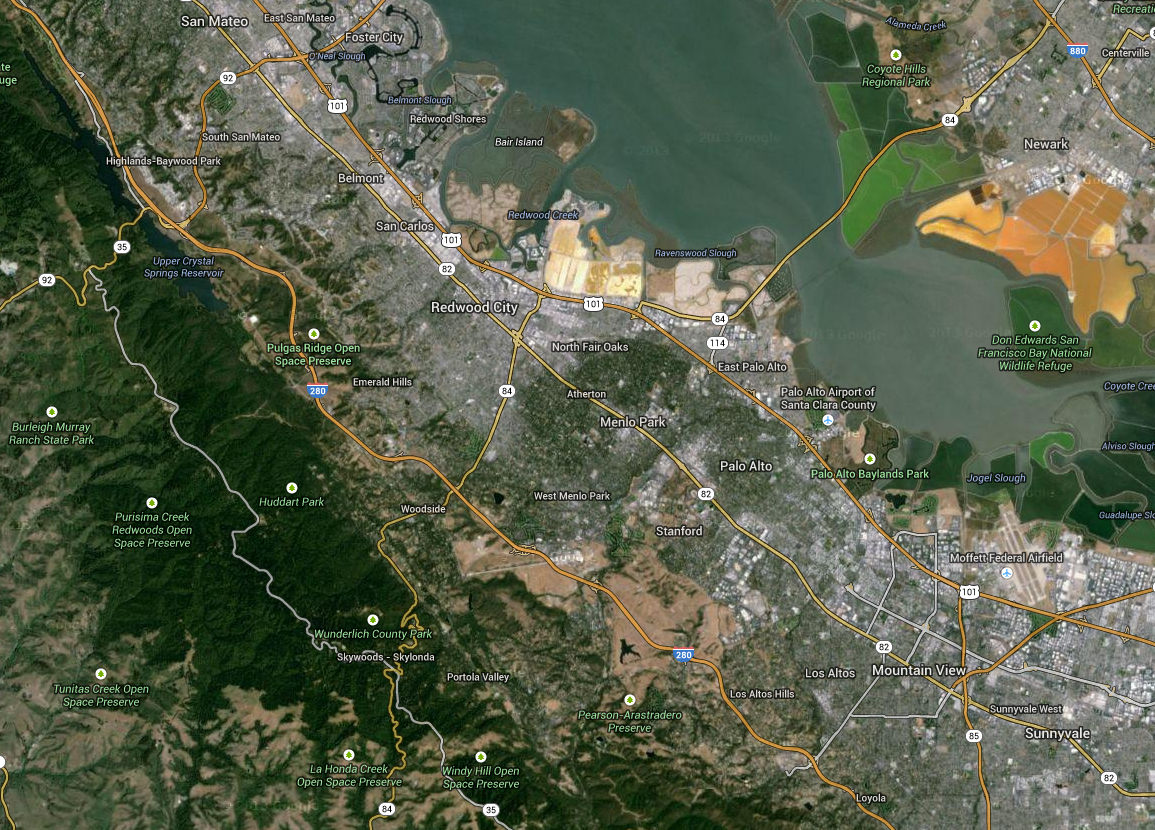
    PaloAltoSatMap

    We’ll call these the “Ask Any Geographer” (AAG) set of reasons not to open the area for residential development. Here are four such reasons that would appear near the top of the list.

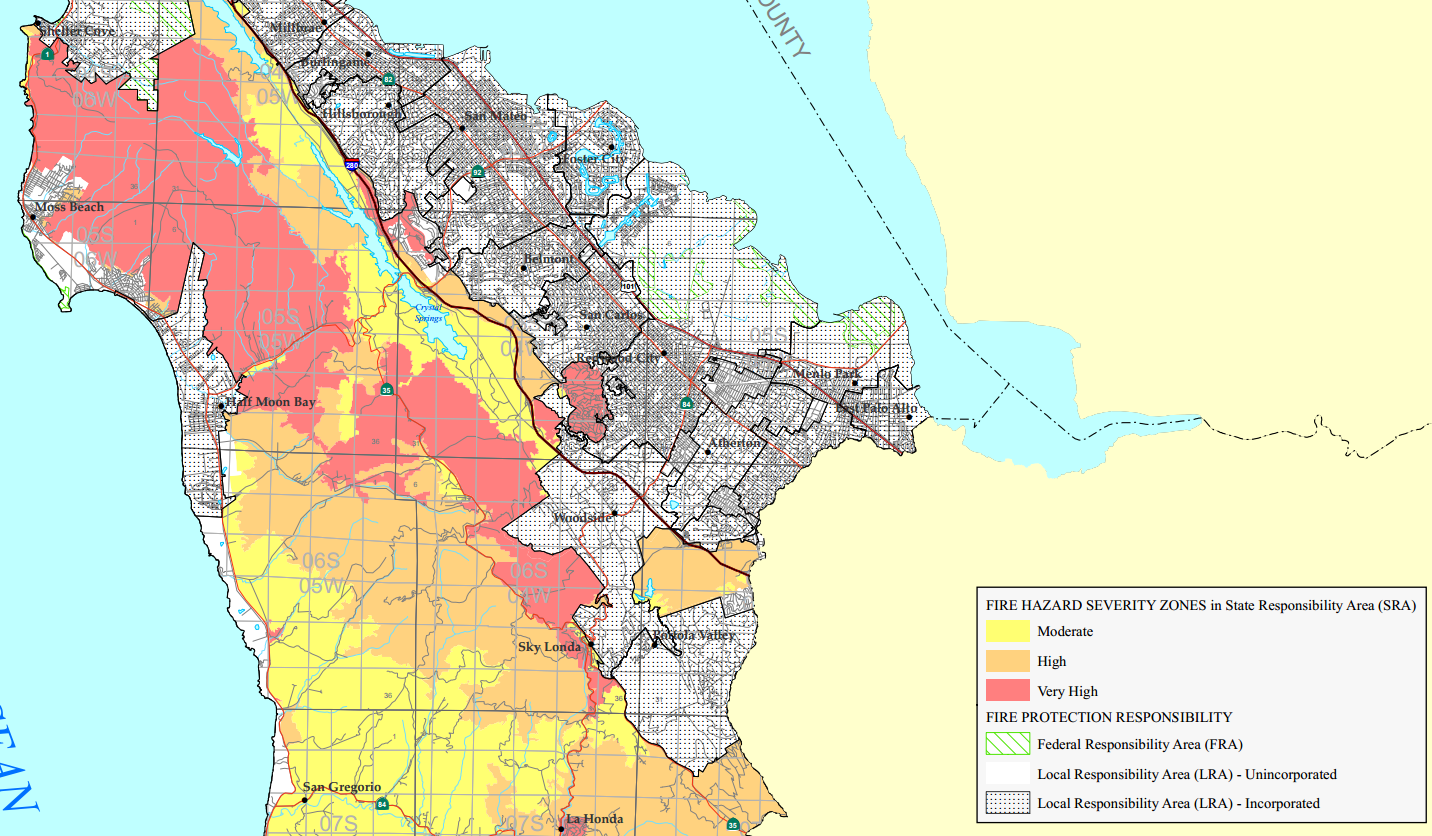
    AAG Reason #1: Wildfires. In my home state of Colorado over 1 Million people reside in areas deemed high risk for wildfire and the cost of protecting property owners from the inevitable wildfire activity in such regions is far too high. Isn’t it funny how fiscal conservatives hate high taxes and want less government but don’t bother to think about downstream risks inherent with build anywhere and everywhere regional planning policies? The mountainous and forested region west of I-280 is a region where wildfires will occur. The question is not if but when. Hey Thomas, how would the supply and demand equation change if New Palo Alto was built, sold and settled but then burned down? Good for the local economy? Real estate and otherwise? Something tells me your “econ 1” model falls apart in such a scenario.
    SFAreaWildfireRisk

    AAG Reason #2: Landslides. As I mentioned above, this region is mostly temperate rainforest. For Dr. Sowell and other economists who might be reading, this means it rains a lot and it’s covered with trees. One of a few potential hazards that occur frequently after heavy rains in mountainous, forested regions are landslides. They can be small and relatively inconsequential or they can be much bigger threatening homes and communities and resulting in fatalities. Recently there were major landslides in the Seattle, Washington area killing more than 40 people, and the area west of Palo Alto is subject to landslide risk as well.
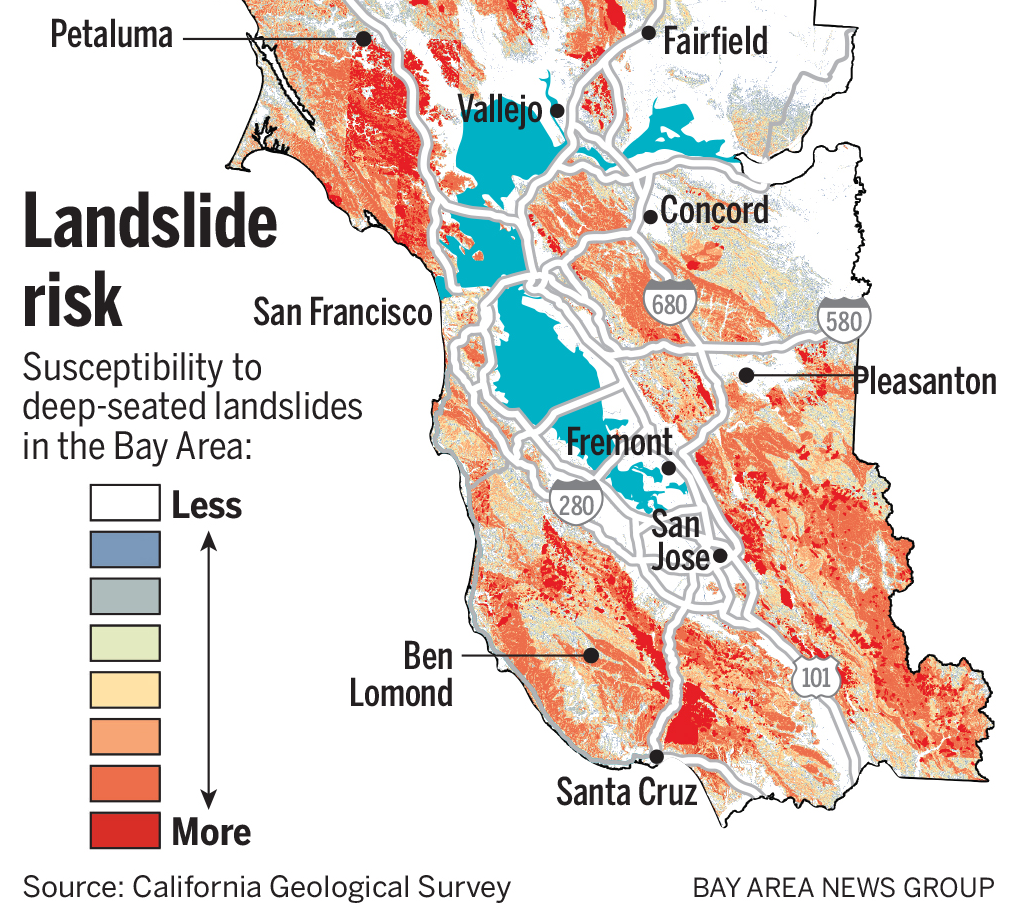
    SFAreaLandslideRiskMap

    AAG Reason #3 Earthquakes. Below I’ve posted a zoomed in view of the “Woodside Quadrangle” area just west of Palo Alto and Redwood City. The shaded area (light yellow) illustrates the location of the San Andreas Fault where major earthquakes have been known to occur from time to time. Remember the big one in 1906? See the highway running just east of the fault line? That’s I-280.
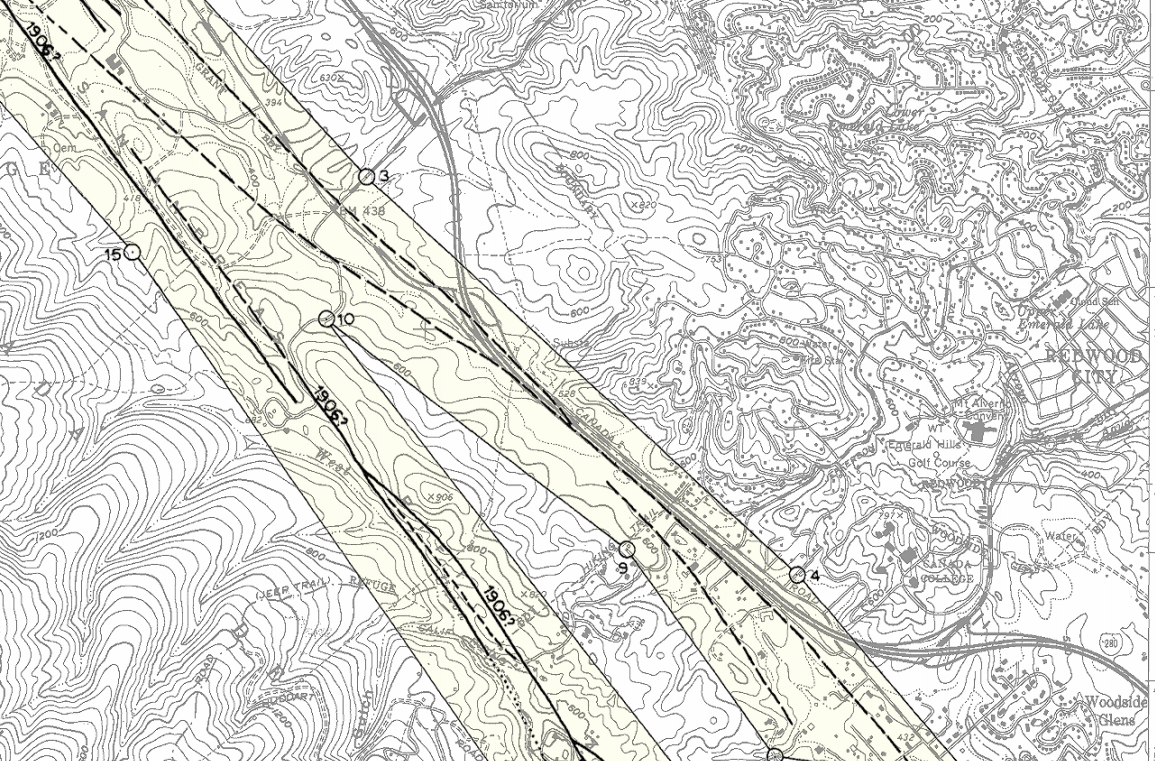
    RedwoodCityFaultLineMap

    There are other natural hazards that pose a threat to the same area, including tsunamis, making it a fairly crummy idea to build high density housing developments directly west of I-280 but I’m starting to feel like I’ve made my point. Plus all this geography is probably blowing up the graphing calculators that are typically so helpful in computing demand elasticity. Perhaps we should return to economics so we’re on a level playing field.

    AAG Reason #4 Prices on the San Francisco Peninsula won’t go down just because supply goes up. This one must just torture economists who continue to stare at their 2-D graph showing how demand always goes down when supply goes up. There are loads of factors that drive real estate prices. Sure supply is one factor. Here are a few others: proximity to employment opportunities, good schools, high-quality entertainment and other cultural amenities. Turns out the San Francisco Peninsula might be one of the best places to live in the entire world if your primary goal is to find a high-paying job near great Thai food restaurants and outdoor live music venues. People also like to live in places with great weather and they like a view of the ocean or the mountains or a lake or a park with trees and flowers. You know, the commodity you refer to as “open space”. Yes, people definitely like open space. Kids like to run around and play. Adults like to walk dogs. In fact, a regular dose of nature is good for our physical and mental health. The ability to conveniently access this type of open space is good for quality of life and when you provide a high quality of life this funny thing happens: people want to live in the vicinity and, voilà, housing demand and real estate prices go up.

    Don’t you find it a bit ironic that the most liberal cities, both globally and in North America, also offer the highest quality of life? Have you considered the possibility that quality of life drives real estate prices and what you refer to as liberal policy tends to foster higher quality lifestyles than the more conservative alternatives? If you disagree you should high tail it out of the Bay Area and move swiftly toward a more properly governed region with solid conservative principles. You know, a place where you can build anywhere and everywhere, a nice city like Houston. Wouldn’t you prefer great sprawling residential developments with unbearable traffic and commute times combined with little to no public transportation. Isn’t it great watching your life tick by while sitting in traffic and breathing oil-enriched air? But, hey, cheap real estate makes all the difference. Give Rice University a call. I’m sure they’d be delighted to bring you on board. Be sure to locate out past Katy where you’ll find inexpensive real estate and only a 90 minute one-way commute.

    So, Dr. Sowell, if you want to talk about how liberals are bad for the economy perhaps you should focus on a topic within your wheelhouse. Maybe you can show how bloated government programs lead to higher taxes and limit economic growth. I’m probably with you on that one…so long as you include military spending. But, if you want to talk about location decisions, throw out your supply and demand charts. Instead, get yourself a good map or, better yet, a good geographer so you can learn more about these thorny spatial variables you and your geographically illiterate colleagues typically refer to as externalities.
    Share:
    More
    • 12 years ago
    • Geography
    • Justin
    • politics
    • wage gap

    Presidential Politics and the Gender Wage Gap in America

    The Paycheck Fairness Act of 2014 was recently defeated in the Senate with Republicans voting unanimously against the bill. Conservatives at the Heritage Foundation argued the bill is based on faulty statistics, would hurt women’s employment prospects and invites too much government interference in the economy. On the other side of the political aisle, Democratic politicians and Women’s rights advocates argued it was a simple issue of fairness. I’m not familiar enough with the language in the bill to do any fact checking or know how it might improve upon or detract from the Equal Pay Act of 1963. In any case, I’m fairly confident both sides are misrepresenting the issue, making it difficult to have an open discussion. After all, it’s politics, right?

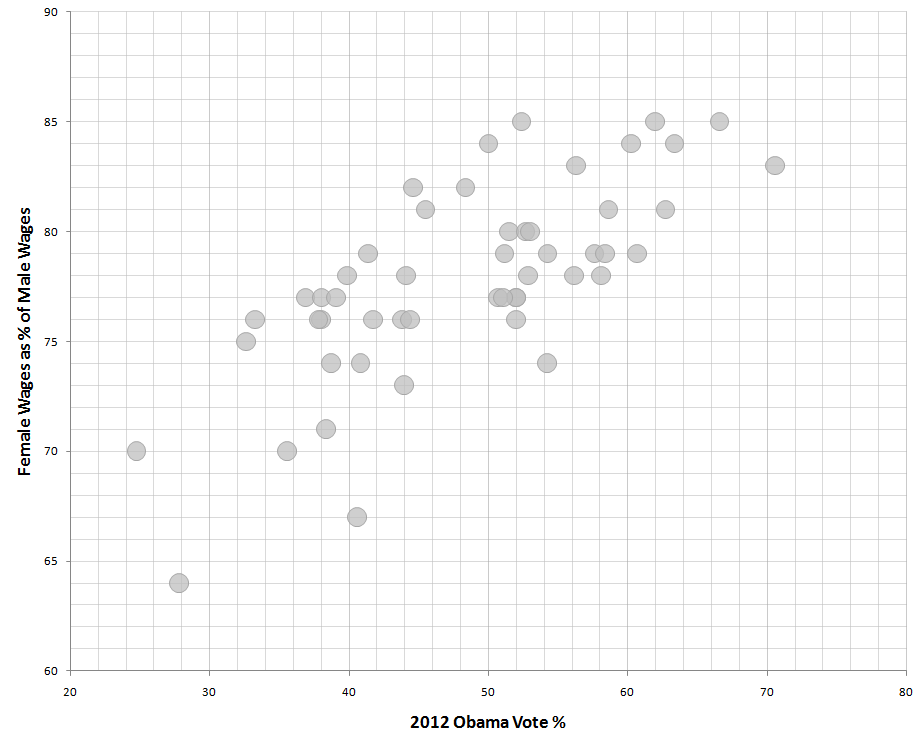
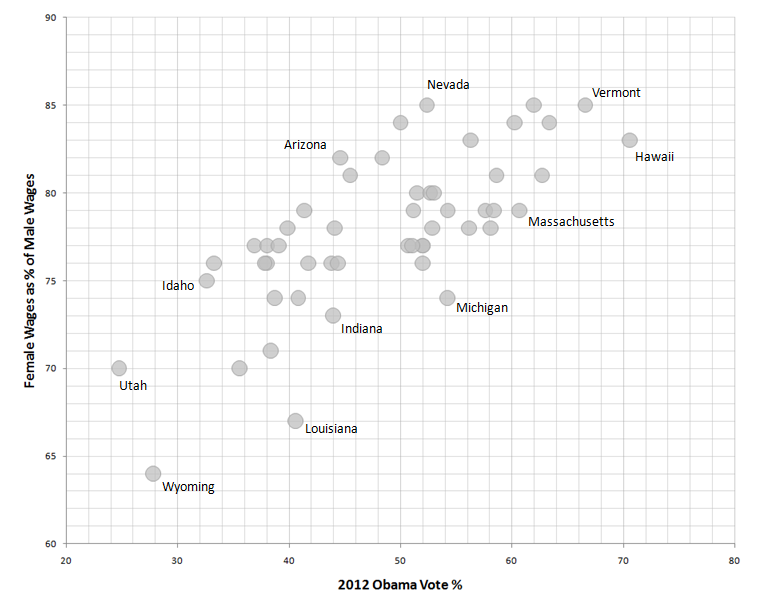
    Out of curiosity I downloaded the State Gender Wage Gap data  along with voting results from the 2012 Presidential Election in an effort to see how voting patterns correlated with wage gap data. As I tell my students, correlation does not imply causation so these data prove nothing. That said, there is a fairly strong positive correlation (Pearson Correlation Coefficient = 0.76) between % Obama votes and Female Wages as a % of Male Wages by State.

    My wife tells me that I should restate the preceding sentence in plain English. Translation: States with a low percentage of votes going to Obama in 2012 are more likely to pay women less; likewise, States with a high percentage of votes going to Obama in 2012 are more likely to pay women more. Like I said, this relationship does not prove that political orientation causes wage discrimination. But, there is a correlation.

    I’ve produced a scatter plot to help visualize the data relationship. Each circle below represents one State.

    WageGap

    I plan to circle back on this topic to examine the geographical dimension. In the meantime, here is the same graph with a few labels.

    WageGapLabels
    Share:
    More
    • 12 years ago
    • Predictive Analytics
    • Justin
    • analytics
    • big data

    Eight (No, Nine!) Reasons Big Data Might Surpass Expectations Despite the Hype

    I recently read an OpEd piece in the New York Times, Eight (No, Nine!) Problems with Big Data. The article was written by two NYU professors, one a psychologist and one a computer scientist. I was looking forward to some interesting new arguments and points of view. I was in for disappointment.

    Here is an abridged version of the 9 problems they see with Big Data.

    1. Big data is good at detecting correlations but doesn’t tell us which correlations are meaningful.
    2. Big data is helpful as an “adjunct to scientific inquiry” but doesn’t replace domain expertise.
    3. Tools produced with big data can be easily “gamed” reducing long-term utility.
    4. Google’s Flu Trends app doesn’t work as well as it once did.
    5. If big data techniques are used for both data collection and analysis there may be pitfalls.
    6. Big data finds “too many correlations” because it explores too much data.
    7. Big data is “prone to giving scientific-sounding solutions to hopelessly imprecise questions” like ranking Francis Scott Key as history’s 19th best poet.
    8. Big data is “best when analyzing things that are extremely common”. Huh?
    9. There is too much hype surrounding Big Data.

    Let’s take a look at these one at a time.

    Problem #1 is straight from the Statistics 101 textbook: correlation does not imply causation. So big data in the hands of someone who never studied statistics could be a problem. Of course this has always been an important axiom for data analysts. Nothing new or significant about this problem with the advent of big data.

    Problem #2 reminds us that we will still need biologists and other scientists with specific domain expertise because big data can’t do the job on its own. Yes, despite coordinated efforts, statisticians and computer scientists have failed to supplant all other scientific disciplines and domain expertise will continue to be valuable. Again, this issue predates use of the term big data.

    Problem #3 warns us that if someone builds a tool with a simple algorithm (e.g., grading papers by looking for use of sophisticated words) then people will be able to figure it out. Darn it. You mean that feeble attempts at laziness might not work…even with big data? I’m starting to see a pattern here.

    Problem #4 is clearly alarming. Google’s Flu Trends doesn’t seem to work well any longer. It was so cool at first. And, now, the whole internet has changed. Jeez. Why would the internet change? It’s sort of like analyzing people and finding a way to predict behavior and then those people change their behavior. Why do they do that? It’s a horrible dilemma but we seem to be stuck re-analyzing data over and over to keep track of changes. Brutal. Why doesn’t big data fix that?

    Problem #5 implies that before big data no one ever created a model with data they collected on their own and then failed to validate said model with a 3rd party independent source. In other words, model validation is still important. Yes, again, even with big data. Damn it!! I still have to pay attention!

    Problem #6 is a major issue if you don’t know anything at all about statistics or data analysis – just like problem #1. The issue here though is that there are correlations everywhere because there is simply too much data analysis going on. Were we better off when we only analyzed a few data sets? I don’t really get this one and I’m surprised the computer science professor allowed this to go to print. Doing more data analysis doesn’t prevent bad interpretation but it doesn’t hurt anything either.

    Problem #7 is the anti-positivist angle. Talk to any social scientist who hated math or statistics. They refer to any effort to quantify as “positivism” and lump this sort of research into a bucket full of other horrible practices like voter discrimination and other parts of the GOP platform. (Aside: if you didn’t go to grad school imagine a chain smoking, hand-waving intellectual want-to-be who uses big words but on the inside is terrified they’ll be discovered as not terribly insightful.) I’ll bet the computer scientist secretly liked seeing Francis Scott Key as #19 on the poet list. Who says he’s not a poet? But, the psychologist doesn’t want us to forget that humans have a right to make arbitrary distinctions between those who rhyme with spoken word versus those who rhyme with lyrics to music. To me, these efforts can provide uniquely useful insights. Sometimes they must be disregarded as whimsical but not always. And what’s wrong with a whimsical perspective from time to time?

    Problem #8 is sort of like … well, we really want to get to 8 or 9 problems. That’s a big number and that way no one will really want to read the entire article because there are so many problems they will simply assume we’re correct and move on to the next article. Big data is good at analyzing “common” things? What does that mean? So big data is good for analyzing baseball and apple pie but it’s bad for analyzing tennis and zucchini bread? There are rules about how much significance can be attributed to inferential findings – again this is Stats 101..okay, maybe Stats 102 – but there’s nothing problematic about looking for a needle in a haystack. The example they give, something to do with translating a book review, has nothing to do with big data and everything to do with the thorny task of language translation. This may come as a shock but “big data” is better with numbers than it is with text.

    Problem #9 – too much big data hype? Perhaps. To me, it’s very exciting that advances in computational power allow us to explore possible solutions to problems that were intractable just a few years ago. Maybe Big Data today is like disco in the 1980s. The Bee Gees were hot but popularity faded a few years later. Or maybe it’s more like the internet in the 1990s. There was way too much hoopla. Remember pets.com? What a joke. After 20 years the internet hasn’t really lived up to the hype…well, except now I work from a home office using a Google Chromebook purchased on Amazon. And you’re reading this on my blog.


    Share:
    More
    • 12 years ago
    • Business
    • Pueblo
    • Justin
    • distribution
    • legalization
    • marijuana
    • pueblo

    A 3-Point Plan for Marijuana Distribution in the City of Pueblo

    An Open Letter to the Pueblo City Council,

    This is a unique moment in American history and Pueblo has a once-in-a-lifetime opportunity to make a huge difference in the lives of ordinary citizens. The question is will Pueblo City Council see this as a unique economic opportunity and behave like entrepreneurs?  Or will City Council allow the “Chicken Little” voices in our community to carry the day and do nothing?

    More than 80 years after the prohibition of alcohol was repealed in 1933 we now have an opportunity to invent a market for marijuana. City Council has begun debating how a legal market might operate within the City of Pueblo.  So far, City Council has been reluctant to allow retail distribution of recreational marijuana within city limits. I agree that a cautious approach has been prudent but I’m now convinced that further delay will cost Pueblo an opportunity to control local distribution and participate in the market opportunity. I worry that business interests from Denver and elsewhere are likely to dominate the business landscape in this new market unless City Council proactively implements a system designed to maximize benefits for the local economy.

    Before I layout some ideas let’s address those who continue paranoid hand-wringing over perceptions of marijuana as a poison that will infect and destroy society. It’s time to read the writing on the wall. First, marijuana is already here and it’s here to stay. Do you prefer that it remain a black market with criminals controlling distribution and the resulting cash cow generated by undeniably persistent demand? If you think marijuana prohibition is or was a good idea you’re clearly operating with your head buried in deep sand. Billions of US tax dollars spent over decades and marijuana use is no less prevalent. Only Mexican Cartels seem to be benefiting from prohibition. Second, marijuana is far less harmful than alcohol. Have you ever heard of a young person dying because they choked on their own vomit after smoking too much weed? No, because it doesn’t happen – but that’s what alcohol can do if consumed in excess. The CDC estimates that excessive alcohol use kills 88,000 people per year in the U.S. So stop being a hypocrite who enjoys a regular 3 martini pre-dinner routine but won’t allow neighbors to smoke a joint on their front porch. Third, marijuana prohibition is over. There may be a few speed bumps along the way but pot prohibition is ending. Not just in Pueblo, not just in Colorado, but all over North America. Get used to it. Your opposition is akin to the 1999 anarchist-led globalization protests in Seattle. You’re too late. That ship has sailed.

    What we should focus on now is how to optimize marijuana distribution in Pueblo. The legal marijuana market in Pueblo should, first and foremost, benefit the citizens of Pueblo. Rather than ceding control of the market to “ganga-preneurs” from Denver or other big money corporate interests from outside our community, we should take this opportunity to build a distribution system that generates both tax revenue and opportunities for Puebloans to cash in on demand for cannabis. I’ve heard local politicians pay a lot of lip service to creating jobs and improving the economy. Well, here is a perfect job creation opportunity, served up on a platter. All you have to do is allow Puebloans to participate.

    There are 3 key links in the marijuana (or any other material) supply chain: production, wholesale distribution and retail sales. There’s no good reason why Pueblo can’t control all three links within the local market and keep the lion’s share of pot profits within our own community.

    Here are my suggestions for making that happen:

    Production. Pueblo County licensing of grow operations has thus far focused on licensing larger scale production with a variety of interested parties (most from out of town as I understand it) applying to grow on rural acreage in the County. The licensing fees are ridiculously high. Add to that the costs to acquire appropriately zoned land and facilities, indoor growing equipment, seeds, soil, etc and 99.9% of would-be entrepreneurs in Pueblo are priced out of the market. Why must we limit production to a scale that requires so much up-front capital? I propose establishing an individual grower license program. Allow individuals to grow cannabis on their own property. Make the application simple and the license fee affordable – maybe $100 per year. This is happening anyway – lots of people growing illegally to supplement their income. Why not legitimize these small grow operations and collect taxes? Why not give citizens with a green thumb (yes, pun intended) an opportunity to produce and prosper? City Council, do you favor job creation? Boom. You just created 1000+ jobs.

    Wholesale. Local growers need a centralized market where they can readily sell their crop. The best model for wholesale marketing is the agricultural cooperative structure like grain coops that exist throughout the American Midwest. If you drive through the corn belt in Iowa or Illinois or Indiana you’ll see large grain elevators in every community. These aren’t simply storage facilities, they also serve as the central market place where local farmers are able to sell their harvest at prevailing market prices. I propose creating a cannabis growers cooperative in Pueblo tasked with the responsibility of purchasing marijuana from properly licensed growers located in Pueblo County. The coop could also test, package and label marijuana for wholesale and retail distribution in Pueblo and throughout Colorado. There’s another 20+ jobs created to staff the coop.

    Retail. To properly distribute marijuana we need a network of appropriately located stores within the city. Politicians who think that Pueblo West locations are satisfying demand are living in a fantasy world. No one wants to drive out to PW to pay a premium for low grade ganja so they are continuing to buy from their existing, illegal source. To successfully legalize you must also kill the black market. Store locations should be conveniently located but scrutinized to minimize exposure to young people. They should be owned by local residents and they should be closely monitored by a local control board to be sure they aren’t selling illegally to minors. Wait…we already have such a network already in place. These locations are licensed to sell products that only adults, age 21 and over, are allowed to purchase. I’m talking of course about liquor stores. I propose allowing retail liquor stores to sell packaged marijuana products.

    Now, if you read my blog regularly you’ll know that I’m biased because I happen to own a liquor store in Pueblo. And, even though the store is currently for sale I recognize this as a clear conflict of interest as it would most likely increase the value of the business. But, I still think the arrangement makes sense. Many people don’t want to live next door to a liquor store or a pot shop. That’s why liquor stores aren’t located next door to parks, schools or single family homes. But, the distribution of substances that should not be in the hands of young people is exactly what liquor stores are set up to provide. Another benefit is that local liquor stores are not controlled by large companies. They are all small locally-owned businesses. Shouldn’t local small businesses and local small business owners be higher on the priority list than companies from outside of Pueblo? Wouldn’t it be better to trust marijuana distribution to people who are well known in the community? I think this makes more sense than having a long series of volatile public meetings where City Council approves zoning rules that lead to new pot shops opening in controversial locations. Do we really need to invite such dramatic conflict? Liquor license holders and their store locations have already been vetted. Why reinvent the wheel?

    So there you have it. My 3-point plan for marijuana distribution in Pueblo.

    City Council members: Puebloans have voted to legalize marijuana and they voted you into office to work for them. Please don’t pass up this economic opportunity just because you calculate that vocal opposition might score points with the Chicken Little wing of your political constituency. A local grower’s cooperative could really help a lot of people in Pueblo and it won’t hurt you or your constituents one bit.

    Please give Pueblo permission to produce and prosper.


    Share:
    More
    • 12 years ago
    • Predictive Analytics
    • Justin
    • fivethirtyeight
    • march madness
    • nate silver
    • predictive analytics
    • statistics

    March Madness FiveThirtyEight Model Challenge

    As part of the Advanced Statistics Class I’m teaching this term, I’ve asked students to build a regression model attempting to replicate Nate Silver’s March Madness Sweet 16 Predictions.

    Nate’s model is built using a variety of factors:

    • Composite of five computer power ratings including Ken Pomeroy’s ratings, Jeff Sagarin’s Predictor ratings, Sonny Moore’s ratings, Jeff Sokol’s LRMC ratings and ESPN’s Basketball Power Index.
    • NCAA Selection Committee Seeding Order
    • Preseason rankings from both the AP and the USA Today Coaches Poll

    Nate also makes adjustments for injuries and travel distance but we didn’t have time to include these factors in class.

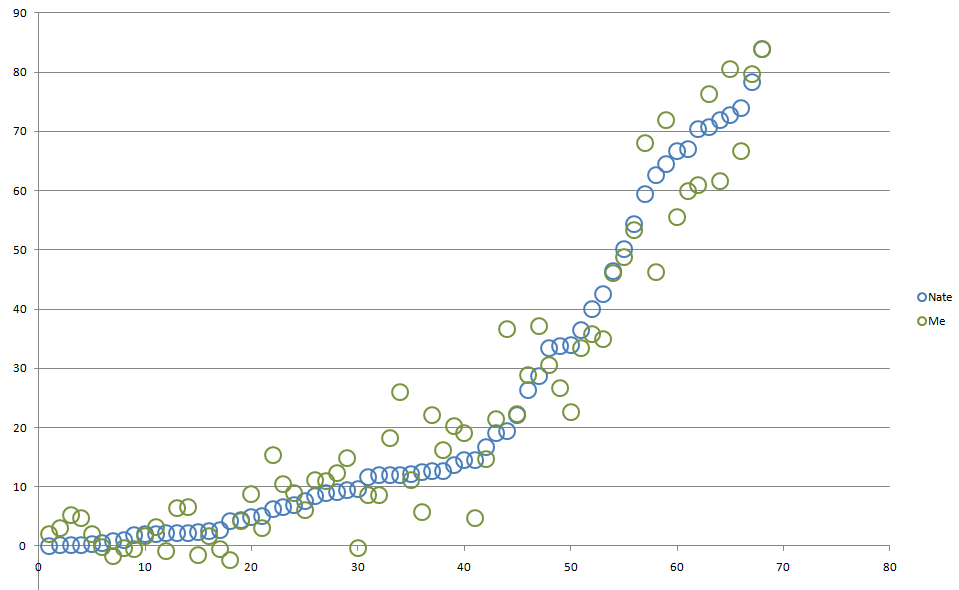
    In preparation for class today I built a model using only two variables: NCAA Seed Order and Sonny Moore’s ratings and was able to reproduce Nate’s % Chance of Reaching Sweet 16 with a fairly high level of accuracy. For stats nerds here is some model output:

    Regression Statistics
    Multiple R 0.9694
    R Square 0.9398
    Adjusted R Square 0.9370
    Standard Error 6.3795
    Observations 68


    ANOVA
    df SS MS F Significance F
    Regression 3 40662.94 13554.31 333.05 0.00000000
    Residual 64 2604.68 40.70
    Total 67 43267.62


    I don’t want to share the regression equation itself because that might ruin the fun for my students. But, here is a comparison chart showing my predictions versus Nate’s along with the raw data further below. You are welcome to use these data for the Billion Dollar Bracket Challenge. All I ask is if Warren Buffet sends you a big check please send me half. Might cover a small portion of the college tuition expenses for my 3 kids over the next 15-20 years.


    MarchMadnessModelCompare


    Team Nate Me Residuals
    Florida 83.9460 83.8147 0.1313
    Louisville 78.3270 79.7111 -1.3841
    Michigan 73.8490 66.7303 7.1187
    Arizona 72.6880 80.4752 -7.7872
    Wisconsin 71.8360 61.6824 10.1536
    Virginia 70.7820 76.3386 -5.5566
    Duke 70.4410 60.9141 9.5269
    Kansas 67.0390 59.9023 7.1367
    Michigan State 66.5930 55.4831 11.1099
    Villanova 64.4580 71.9180 -7.4600
    UCLA 62.6920 46.1987 16.4933
    Wichita State 59.3560 67.9480 -8.5920
    Creighton 54.3760 53.2811 1.0949
    Syracuse 50.1450 48.7612 1.3838
    Iowa State 46.3800 45.9931 0.3869
    San Diego State 42.5320 34.9598 7.5722
    Ohio State 40.0770 35.8186 4.2584
    North Carolina 36.3760 33.4644 2.9116
    Kentucky 33.9020 22.6230 11.2790
    Baylor 33.8120 26.6866 7.1254
    Oklahoma 33.3590 30.5882 2.7708
    Virginia Commonwealth 28.6660 37.0897 -8.4237
    Connecticut 26.3150 28.9027 -2.5877
    New Mexico 22.1610 22.2339 -0.0729
    Cincinnati 19.4840 36.6941 -17.2101
    Oregon 19.1420 21.3953 -2.2533
    Memphis 16.6600 14.6652 1.9948
    North Dakota State 14.5470 4.7441 9.8029
    Oklahoma State 14.4280 19.1470 -4.7190
    Pittsburgh 13.6190 20.2434 -6.6244
    Gonzaga 12.6190 22.0542 -9.4352
    Texas 12.6190 16.2179 -3.5989
    Arizona State 12.5200 5.6537 6.8663
    Providence 12.1140 11.0555 1.0585
    St. Louis 12.0300 25.9545 -13.9245
    Tennessee 11.9940 18.3063 -6.3123
    George Washington 11.9910 8.6488 3.3422
    Harvard 11.6070 8.6408 2.9662
    New Mexico State 9.5620 -0.3737 9.9357
    Iowa 9.3960 14.8457 -5.4497
    Nebraska 9.1640 12.2987 -3.1347
    Stanford 8.9180 10.9164 -1.9984
    Saint Joseph’s 8.3540 11.1070 -2.7530
    Dayton 7.6260 6.1262 1.4998
    BYU 6.9540 9.0155 -2.0615
    Kansas State 6.6050 10.5180 -3.9130
    Massachusetts 6.2340 15.3853 -9.1513
    North Carolina Central 5.1300 3.1089 2.0211
    Xavier 4.8220 8.8253 -4.0033
    Tulsa 4.4580 4.2679 0.1901
    Stephen F. Austin 4.1830 -2.4063 6.5893
    Louisiana-Lafayette 2.6470 -0.4934 3.1404
    Manhattan 2.5570 1.7351 0.8219
    Delaware 2.3160 -1.5629 3.8789
    North Carolina State 2.2640 6.6363 -4.3723
    Colorado 2.2420 6.3846 -4.1426
    Western Michigan 2.1510 -0.7670 2.9180
    American University 2.0690 3.2675 -1.1985
    Mercer 1.9350 1.6642 0.2708
    Eastern Kentucky 1.8820 -0.5050 2.3870
    Wofford 1.0120 -0.3110 1.3230
    Milwaukee 0.8740 -1.6194 2.4934
    Coastal Carolina 0.5670 -0.1038 0.6708
    Weber State 0.2660 2.1002 -1.8342
    Albany 0.1130 4.7816 -4.6686
    Cal Poly 0.0910 5.2246 -5.1336
    Mount St. Mary’s 0.0800 3.0392 -2.9592
    Texas Southern 0.0450 1.9538 -1.9088


    Share:
    More
    • 12 years ago
    • Pueblo
    • Justin
    • Colorado
    • energy
    • New Urbanism
    • pueblo
    • solar
    • sprawl

    Momentum is Building in Pueblo!

    Momentum is building in Pueblo as some of the factors I’ve written about previously are beginning to play out right before my eyes.

    Earlier this month Community Energy and Xcel announced plans to build the largest solar array east of the Rocky Mountains near the Comanche Power Plant on the south edge of Pueblo. To me this project, if executed properly, will solidify Pueblo’s rightful place as the solar energy capital of Colorado.

    In addition, I’m hearing from more and more people who are becoming disenchanted with Denver’s traffic, sprawl and high prices. They’re looking for a smaller, less congested community with lower costs. Pueblo fits the bill perfectly.

    Unfortunately, it looks to me like Denver is moving closer and closer to becoming the LA of the Mountain West. Pursuing growth for growth’s sake has consequences. You just can’t continue to issue construction permits everywhere. Pueblo still has an opportunity to prosper without following Denver’s unsustainable path of sprawl. Instead, Pueblo should look to examples of New Urbanism by promoting public transportation, walkable communities and urban growth boundaries to limit sprawl and a car-dependent culture.

    I hope the momentum continues but when growth arrives I hope Pueblo follows a more sustainable path to prosperity.


    Share:
    More
    • 12 years ago
    • Education
    • Justin
    • graduate school

    More Tips on Grad School

    Recently I wrote about 3 Secrets to Success when applying to graduate school. I received some positive feedback from a few folks including a suggestion to check out a blog written by Matt Might, a Computer Science professor at the University of Utah.

    Matt’s blog is a treasure trove of useful suggestions. His posts are especially useful if you’re in some stage of academic life, from undergrad on up to tenured professor. If you’re interested in studying GIS at the graduate level the following blog posts are geared toward computer science but entirely applicable and spot on.

    • HOWTO: Get into grad school for science, engineering, math and computer science
    • How to get a great letter of recommendation

    I recommend browsing his long list of articles for great tips on productivity, writing, programming, academia, etc.

    Share:
    More
    • 12 years ago
    • Business
    • Geography
    • Justin

    GIS Software Leader Responds to Market Competition with Higher Prices

    Palm Springs, California – Software provider ESReye announced today, during its annual developer summit, that it will respond aggressively to competitive threats from open source software products like QueueGeeIS and cloud-based services like MapBocks by raising prices.

    According to Irwin M. Fletcher, ESReye Executive Vice President of Marketing, “It’s never been more difficult to stand out in the GeeIS software market but we are clearly the leader in high prices and we intend to stay there.” Despite successful gains in software industry market share by Lintux, OpenOffIS, OpenStreakMap and other so-called “freeware” products over the past several years ESReye intends to continue to pursue market leadership by focusing on high prices. When asked about this unique strategy, Mr. Fletcher replied saying “QueueGeeIS and other competitive software packages now provide nearly identical capabilities to ArcGeeIS and, as we explored opportunities to differentiate ourselves, we realized that pricing was a key feature where we were uniquely positioned to lead the way.” Mr. Fletcher said that higher prices would take effect as early as next week but declined to convey specifics, stating, “Like most proprietary enterprise software vendors we prefer to avoid transparency when it comes to pricing. We have found that by making it difficult to understand terms for individual or enterprise software license packages we are able to increase revenue on a per-customer basis and maximize profitability.”

    When asked to comment on the move, a veteran software industry analyst who asked to remain anonymous said, “Hey, why not? Seems to be working for OraKool.”

    This blog post is a satirical publication. The contents of this material are © Copyright 2014 by Justin Holman and may not be reprinted or re-transmitted in whole or in part without the express written consent of the publisher. Any use of real names is accidental and coincidental.


    Share:
    More
    • 12 years ago
    • Education
    • Justin
    • admission
    • degree
    • graduate
    • graduate degree
    • Master's
    • PhD
    • school

    How to get into Graduate School: 3 Secrets to Success

    Since I started blogging about careers in GIS and graduate programs in geography I’ve received many emails and comments from people who want to get into grad school. Many of them don’t really know where to start. When I started thinking about grad school back in 1991-1992 I didn’t know where to start either. If I could go back in time, here are the three key insights I’d share with my younger, better-looking self.

    Before I get into the 3 insider secrets let’s define what I mean by grad school. The type of grad school I’m talking about here is a research-oriented Master’s or PhD program. I’m not talking about Medical School, Law School, B-School (except if you’re going for a PhD in Business rather than an MBA). Engineering school may well be a completely different world as well.

    My PhD is in geography so my experience is most relevant to those considering a Master’s or PhD in geography. That said, geography is unique and I’m a bit of an oddity as well. Geography cuts across social sciences and physical sciences and shares some sliver of an academic Venn diagram with Computer Science, Statistics and perhaps even Visual Art and Graphic Design (via Cartography). In my case, I had a Professor of Computer Science on my dissertation committee. I took grad level courses in Economics and Business Statistics and for 5 years I worked closely with PhDs in Operations Research and Supply Chain Management. I also worked for the USGS and interacted with environmental science types for 2 years. So I think it’s safe to claim some ability to provide guidance outside the realm of geography. However, you will need to decide for yourself how applicable my experience is to your particular field of study.

    Secret Tip #1. Grad school is an apprenticeship. If you think about grad school as another set of courses to take with a project or thesis to write at the end, similar to the typical undergraduate college experience, you’re missing the mark. The best way to approach grad school is to think of your advisor as a mentor who will help to train you in a particular area of research. This is most certainly true at the PhD level and you’ll get more from your studies if you treat a Master’s degree the same way.

    In addition, this has implications for selecting target academic departments. Rather than exploring different programs you should be evaluating different professors as potential mentors. Most students, I think, spend a lot of time weighing the pros and cons of various programs, departments, and Universities. And I don’t mean to dismiss this approach all together. In fact, it’s critical to find a department and a University where you can be successful. But, in my opinion, your choice of advisor is more important than any other consideration. This means that in searching for the right graduate school you should focus first and foremost on finding the right professor to become your research mentor. Turns out that this is good practice for graduate school generally and for research specifically because you need to start by conducting a literature review. This forces you to read research articles and identify an area where you’d like to make a contribution. Along the way you’ll begin to identify key players in your field of interest. Write down their names. Find out where they teach. Look at their CV. Read their papers. Send them an email. Try to reach them by phone. Meet them at a conference. Offer to buy coffee or lunch. Ask if they need a hard-working grad student to help advance their research agenda. Don’t be annoying but be persistent. This will put you on their radar screen. And, as you’ll see below, you don’t want to be anonymous when you apply for admission.

    Secret Tip #2. Standardized scores are critical. It’s not really fair but it’s the reality facing admissions committees in any department that receives far more applicants than spots available. It’s not fair because standardized tests are culturally biased. If your cultural background is markedly different than most of middle America it can be a challenge to achieve a good score. If you’re a lousy test taker coming from middle America you’re in even worse shape because members of the committee won’t be able to excuse a low score.

    Why are test scores so important? Because the logistics of admissions make it so. Here’s the reality. A graduate department admissions committee might consist of 2-3 faculty and 1-2 grad student assistants. Let’s say the committee has 20 spots available for new students and receives 120 applications. First the committee will likely have a few slam dunk candidates (try to be this type). Maybe a professor has already expressed a desire to bring in 1 or more students (see Secret #1 above to join this crowd) or maybe a student has already secured their own external funding (via NSF grant or comparable). These applicants, let’s say 5 of them, are already in and now you’re down to only 15 spots available from 115 applicants. Wouldn’t it be nice at this point if the committee read each and every application package word for word and thought long and hard about how successful the candidate might be? Yes, it would be nice. But it would take too much time. So, what does an admissions committee do? They rank the candidates. What’s the easiest/best way to rank candidates? Standardized test scores.

    Wait, why don’t grades matter as much or more? Well, because how do you compare a straight A student who graduated with honors from East Tennessee State University to a student who graduated with a 3.1 GPA from Dartmouth? How do you compare a Film Studies major with a 3.8 GPA to a Mechanical Engineering major with a 2.9 GPA? You tell me who’s the better prospective grad student. Not so easy is it?

    And what about the applicants personal statement? Doesn’t that matter? Yes, it’s the tie-breaker. So, after the insider admits (again, see Secret #1) the committee will likely group the remaining applicants as follows: (1) top candidates, (2) middle of the pack and (3) no chance. So the “no chance” group is tossed out right away. No one probably even bothers to read their entire application packet because their GRE scores are so low. It’s sad, yes, because some of these applicants may have been very successful. But do you think the tenured Associate Professor who chairs the admission committee is going to get promoted to full Professor based on diligent student admissions efforts? Nope. Let’s say there are 25 applicants in the “no chance” group. So now we’re left with 90 remaining candidates in the “top candidates” and “middle of the pack” groups. Who are these top candidates? They are probably the applicants who scored highest on the GRE, with a few exceptions. So the committee will scrutinize this top group looking for reasons to exclude someone. Maybe they toss out a few but 10 applicants in the top group are given the green light for admission. That leaves 5 spots to fill from a pool of 80 remaining applicants. So now the committee members go to work combing through these applications to see who rises to the top. Let’s say each member of the committee dedicates a full 15 minutes to each application packet. That’s 20 hours of work. Or 5+ hours each for a 4-person committee. Maybe they have a week to come up with recommendations and meet again for another hour or two to make decisions.

    So, you can see that it’s difficult to stand out. Your personal statement is absolutely critical. Your GPA is critical too. It helps to have attended a well-respected undergraduate institution. But, due to ease of use in the ranking/sorting process, I would argue that your GRE or GMAT is the most important factor if you are applying “anonymously”, meaning you failed to take my recommended approach in Secret #1.

    Secret Tip #3. If you’re not offered funding you probably should not attend. If you’re going for a research Master’s or a PhD your studies should be funded by the department in exchange for teaching or research and/or related administrative work. This is the standard arrangement. If you’re admitted but expected to pay full tuition my advice is don’t go.

    This is perhaps the biggest difference between research-oriented grad school and MD, JD, MBA and other professional programs. The best MA/PhD candidates don’t pay tuition. This is one reason why I think the PhD is a great path even if you aren’t after a tenure track professor gig. The education is outstanding and it’s “free” or at least you walk away debt free. This is in stark contrast to the high-flying doctors, lawyers and bankers who make bigger bucks but typically must pay off big grad school debt as well.

    There are certainly exceptions to this rule. Sometimes it makes sense to pay full-fare for a Master’s degree that will set you up for the best possible PhD opportunities. But, generally speaking, if you are granted admission but the department doesn’t consider you worthy of a teaching or research assistant position, you’re better off waiting a year to try again or going elsewhere.

    It’s not just the financial part of the equation; there is also an important perceptual difference. You won’t be thought of as a colleague by faculty if you’re paying tuition and attending classes like an undergrad. On the other hand, if you’re helping to teach or do research and you’re involved in department activities the faculty will think of you as part of the starting line-up. And when you’re a starter you get to play (and learn) more than those sitting on the bench.

    There are certainly other considerations and probably many more insider secrets that I don’t know. But, these 3 tips just might set you far enough apart from the field to grab the attention of a professor in your field of interest. And finding the right advisor can make all the difference.

    I was lucky enough to find a great mentor who was willing to give me a chance. His gamble and guidance certainly made all the difference in my career.


    Share:
    More
    • 12 years ago
    • Business
    • Pueblo
    • Justin
    • Colorado
    • retail liquor

    The 3 Lessons I Learned After Accidentally Buying a Liquor Store

    I bought a liquor store last year….it was sort of an accident.

    No, I wasn’t binge drinking at the time. I wasn’t really shopping for a liquor store. I wasn’t even shopping for a bottle of wine. But, here I am … proud owner of a liquor license and a terrific selection of craft beers, pinot noirs and small batch bourbons….among many other standard liquor store offerings.

    Since 2010 I’ve been investing in real estate in Pueblo, Colorado and when a commercial building with retail on the ground floor and multifamily residential on the second floor was listed for sale I went to take a look. I liked the building, especially the location in the heart of Pueblo’s Mesa Junction neighborhood. As I walked around with the owner, it became clear that the liquor business was being sold with the building.

    Hmm. Intriguing. My college buddies would be so jealous.

    mjws-map

    So, deciding to roll the dice, I made an offer. I fully expected a counter-offer that wasn’t sufficiently attractive, allowing me to walk away and go back to business as usual.

    Instead, the owner accepted my offer…..hey, that’s great newwwwzzz….holy shit.

    With the building under contract I began due diligence. I remember thinking, before I ever contemplated the notion of liquor store ownership, retail liquor stores enjoy a tidy little monopoly. Must be nice. Well, yes and no. It’s not quite as easy as it sounds. Since taking ownership of the store I’ve learned a few things about the liquor business that might surprise you.

    3tier-721x1024

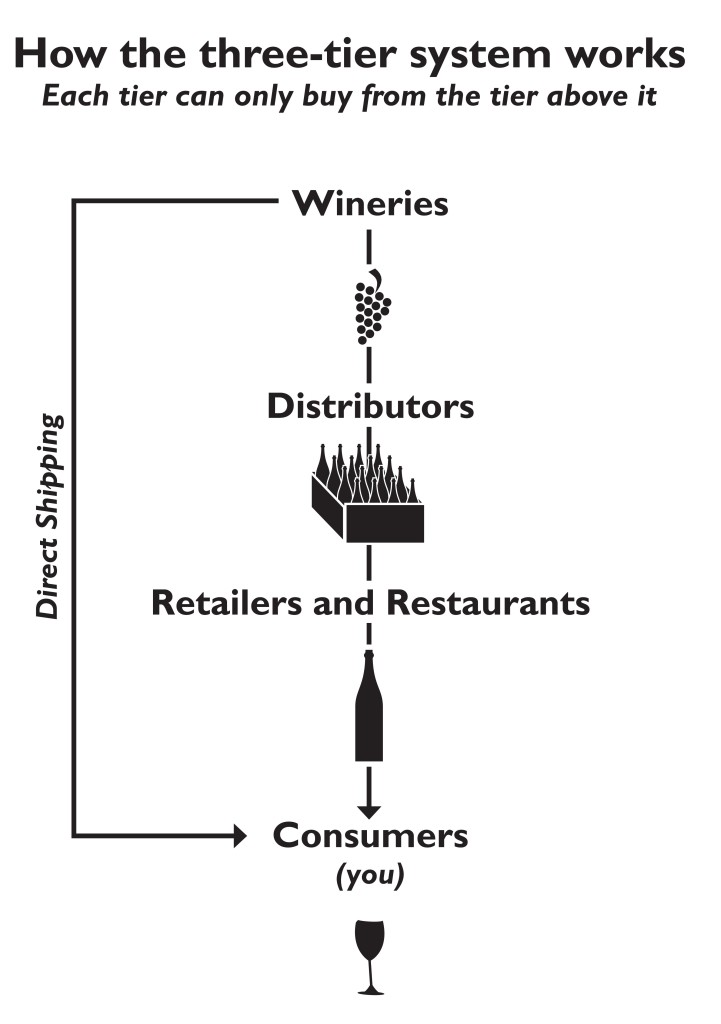
    Lesson 1. The liquor business is highly complex. Retail liquor, at least in Colorado, is a fascinating business. Huge number of SKUs. The quantities of categories, brands, flavors, price points and size variations are mind-numbing. Talk about Big Data. Liquor distribution is heavily regulated in Colorado with a 3-tier system composed of manufacturers, distributors and retailers; each tier has its own set of rules and requires its own special license with an application paperwork trail that only a lawyer could love. Inventory is expensive and margins are thin, managing inventory and cash flow is extraordinarily difficult and SKU level demand is nearly impossible to forecast accurately. Running a small liquor store requires business acumen – accounting, operations, human resources, customer service, marketing, sales – the whole enchilada. If you were thinking that a liquor store is like an advanced lemonade stand you’re completely underestimating the task. This is good by the way. Communities need opportunities for individuals to learn how to run a complex business with full P&L responsibility. 

    Lesson 2. Distributors hold all the power. As a retail liquor store owner I am only allowed to purchase inventory from a licensed distributor. Seems reasonable to keep tabs on who’s moving liquor around the state. But, here’s the catch. Every licensed distributor has a complete monopoly on every product they sell. So, any self-respecting liquor store should have various sizes of Jack Daniels on the shelf, right? I think I’ll call around and see who has the best deal on a case of 750 ml bottles of Jack, compare prices/terms and place the order, right? Wrong. If you want to buy Jack Daniels or any other product whether it’s a brand of beer, wine or spirits, you have your choice of exactly one distributor who carries that product. So, negotiating price isn’t an option. The only possible way you can get any sort of discount is by purchasing large volumes. As a result, the distributors pass along more favorable prices to the mega-stores who can afford to purchase 100 case deals; if you’re a small liquor store you just have to bend over and take whatever price is offered. When I learned this was the way the system worked I was stunned. What? [fade to the Caddyshack scene with Chevy Chase talking to Danny Noonan, “Is this Russia? This isn’t Russia.”]  

    caddyshack-russia

    You mean to tell me that we aren’t allowed to shop around for a supplier who might provide better service, better prices or both? Nope. The Budweiser distributor welcomed us to the industry by requiring cash upon delivery for the first 90 days. No checks. No 30-day net invoice. Not even a money order. Cash on the barrelhead. Nice manners, Bud. 

    Lesson 3. Owning and operating a small liquor store can provide a comfortable income and job security but it’s no cash cow. If you read my About page you’ll see that I have a day job in a completely separate industry. I don’t work in the liquor store. I hired a manager to run the operation and she supervises a handful of employees who staff the store when she can’t be there. She’s paid a decent salary providing a reasonably comfortable living in Pueblo. We pay hourly employees a decent wage as well. It’s not lucrative but I’m willing to bet we pay better than comparable positions at local grocery or convenience stores. The store is humming along. We did a good bit of business around the holidays and customer traffic is steady. But here’s the thing. This business is not designed for an “absentee” owner because after payroll and inventory replenishment there’s not much left over. However, the setup is perfect for an owner-operator.

    As an owner-operator of a liquor store you have roughly the same job security as a tenured college professor. The store could go under if you fail to compete effectively or if the market for liquor dries up somehow (just like a school could close or an academic department could be eliminated). And, your take-home pay will vary with some years better than others depending on volume. But, so long as you have customers who walk in the door, no one can really take away your job.

    Sure, I wish the store was a huge cash cow; you know, pay myself a nice salary every month and do whatever I want all day. Sounds great in theory but as a member of the community I’m glad it’s not so easy because big corporate greed would quickly follow. It’s nice to have the owner behind the counter. Customer service is better. And, it’s nice that the liquor store provides a comfortable income. That way the owner is highly unlikely to sell booze to minors – there’s too much at stake to break the law for a few extra bucks. Mostly, it’s nice that a big company can’t swoop in and take over every liquor store in sight. In the name of low prices, they’d shut most or all of the small stores down and open newly constructed mega-locations on the outskirts of town where land is cheap and profit maximized, laying to waste neighborhood small markets within walking distance….sort of like what’s happened with the grocery industry.

    This dispersed single-unit ownership system is better for the community because it provides economic activity in a variety of locations along with solid living wage jobs that can’t be readily outsourced or automated. More people have skin in the game and a strong incentive to take care of their stretch of sidewalk in the community. In fact, aside from the distributor monopolies and the cumbersome government licensing process, it just might be a model worth considering for distribution of other commodities, like fresh food.

    But that’s a topic for another blog post.


    Share:
    More

    Posts pagination

    1 … 8 9 10 … 17

    Archives

    Popular Posts

    • Why Relocate to Pueblo Colorado
    • The 3 Lessons I Learned After Accidentally Buying a Liquor Store
    • 2014 Rankings - Top 10 Graduate GIS Programs
    • 2015 Rankings - Top Graduate Geography Programs for Spatial Careers
    • 2017 Geography Graduate Program Rankings

    Recent Posts

    • An Ode to My Students
    • Forecasting Confirmed COVID-19 Cases
    • Climate Anomalies and Aftermarket Part Sales
    • Weather and Climate Data for the Automotive Aftermarket
    • Technology Jobs in Pueblo

    Recent Comments

    • Joe on Lesson 2: World Regions and Theories of Uneven Economic Development
    • Justin on Pueblo Neighborhoods 1.0
    • Raj on The 3 Lessons I Learned After Accidentally Buying a Liquor Store
    • Maggie on Pueblo Neighborhoods 1.0
    • Justin on Pueblo Neighborhoods 1.0

    © Geographical Perspectives, 2017

    Site Managed by Gecko Designs

    Forget password?

    What are you looking for?