Geographical Perspectives
    • Home
    • Geography
    • Pueblo
    • Teaching
    • About
    • Aftermarket Analytics
    • 13 years ago
    • Business
    • Education
    • Justin

    Back to the Classroom this Fall

    Today is the first day of class for me. I will be teaching “Inferential Statistics and Problem Solving” in the Hasan School of Business at Colorado State University, Pueblo.  I’m really excited about it actually.  If you’re interested in the subject matter (I mean who wouldn’t be interested in inferential statistics?), feel free to follow along as I will be posting assignments, resources, information, commentary, etc on a course blog page that I’ve set up.

    Here’s the link: http://busad265.wordpress.com/

    If you’re an academic type and have come across good resources for teaching in general, teaching statistics specifically, testing, grading, etc. Leave me a comment below.

    Here’s to a great semester!
    Share:
    More
    • 13 years ago
    • Pueblo
    • Justin
    • commuter tax
    • pueblo
    • sales tax
    • sprawl

    Funding the City of Pueblo

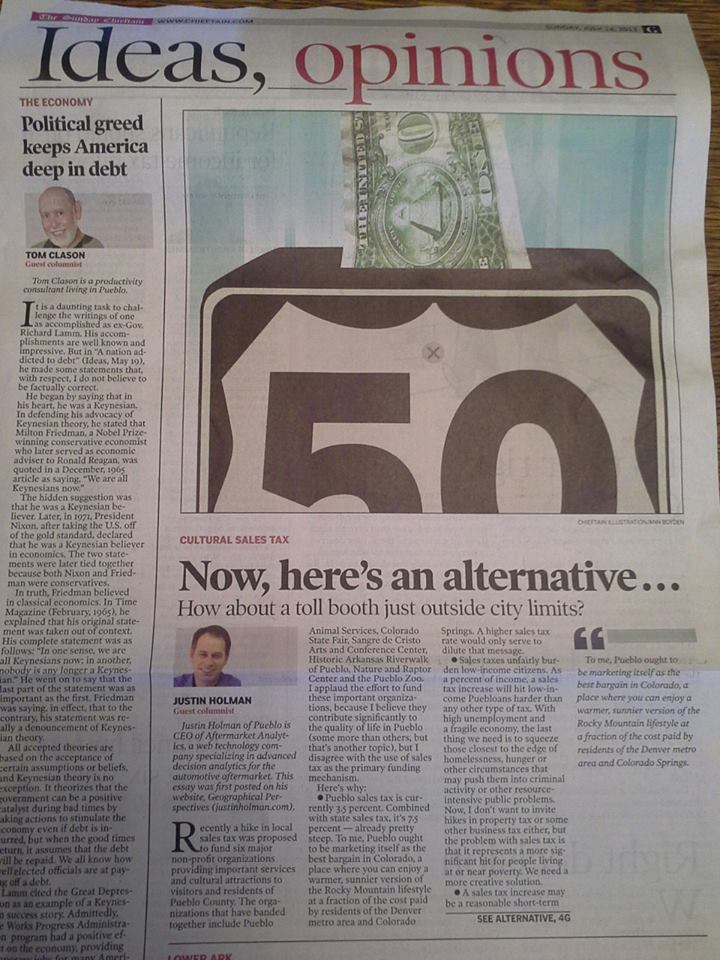
    This piece was published as a guest column in the Opinion Section of the Pueblo Chieftain on July 14. 2013.  Scroll down to see a full-size picture of the front page of the section.

    Recently a hike in local sales tax has been proposed to fund 6 major non-profit organizations providing important services and cultural attractions to visitors and residents of Pueblo County.  The organizations that have banded together include Pueblo Animal Services, Colorado State Fair, Sangre de Cristo Arts and Conference Center, Historic Riverwalk of Pueblo, Nature and Raptor Center and the Pueblo Zoo.  While I applaud the effort to fund these important organizations, because I believe they contribute significantly to the quality of life in Pueblo (some more than others, but that’s another topic), I disagree with the use of sales tax as the primary funding mechanism.

    Here’s why:

    1. Pueblo sales tax is currently 3.5%.  Combined with State sales tax that’s 7.5% – already pretty steep.  To me, Pueblo ought to be marketing itself as the best bargain in Colorado, a place where you can enjoy a warmer, sunnier version of the Rocky Mountain lifestyle but at a fraction of the cost paid by residents of Denver Metro and Colorado Springs.  A higher sales tax rate would only serve to dilute that message.

    2. Sales taxes unfairly burden low-income citizens.  As a percent of income, a sales tax increase will hit low-income Puebloans harder than any other type of tax.  With high unemployment and a fragile economy, the last thing we need is to squeeze those closest to the edge of homelessness, hunger or other circumstances that may push them into criminal activity or other resource-intensive public problems.  Now, I don’t want to invite hikes in property tax or some other business tax either but the problem with sales tax is that it represents a more significant hit for people living at or near poverty. We need a more creative solution.

    3. A sales tax increase may be a reasonable short-term band-aid to help important organizations get through another fiscal cycle but, on a long-term basis, I would prefer that these organizations remain part of the general budget and I would prefer efforts to diversify sources of revenue to properly fund ALL local public services.  A higher sales tax won’t help revitalize Pueblo’s downtown core and it won’t encourage more people to choose Pueblo as a great place to retire, go to college or raise a family.  Actually, it may weaken all these things by encouraging people to move outside the city where sales taxes are lower.  We want to encourage people to move into the City of Pueblo not encourage flight to the periphery of the county.

    That’s the list of problems I see.  I don’t like to criticize without offering my own solution.  So, here’s what I would propose as an alternative.  I like this idea because it would both raise revenue and deter sprawl.  Along with development of the Riverwalk and the Creative Corridor and other efforts to revitalize Pueblo’s central business districts we should be discouraging people from living in far out suburban and exurban locations where they increase traffic congestion and utilize city services without contributing a fair share to the property tax base or to the vitality of the city.

    So, what’s the solution?

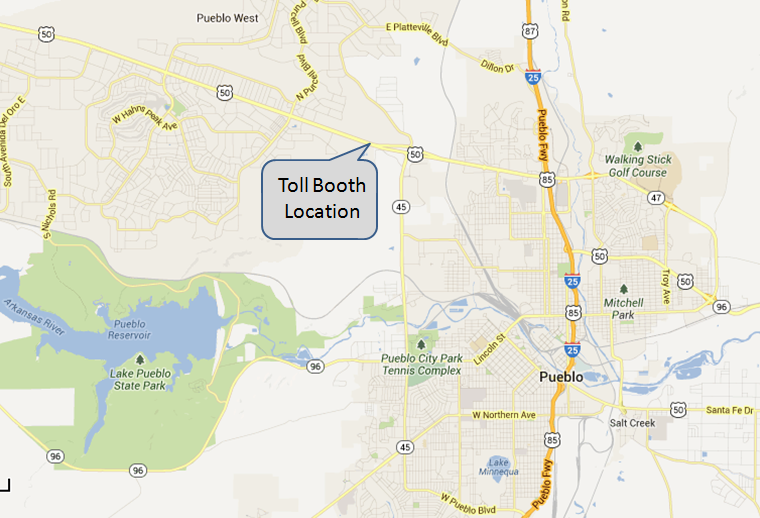
    Install a toll booth on US Highway 50,  just west of Pueblo Boulevard and charge a fee for all eastbound passenger vehicles (driving from Pueblo West into Pueblo).  Here’s why this solution makes sense to me.  First, it targets individuals who obviously want to utilize Pueblo’s amenities but don’t pay a fair share of municipal taxes.  Second, it would serve to reduce traffic on US 50, the most congested stretch of road in Pueblo County.  Currently, the traffic count is in the neighborhood of 50,000 vehicles per day.  If we charge $1 per inbound vehicle we would generate tons of cash to keep our important cultural organizations afloat and maybe some left over to help fight crime or improve public schools.  Third, this commuter tax would discourage additional sprawl in Pueblo West.

    pueblomap-tollbooth


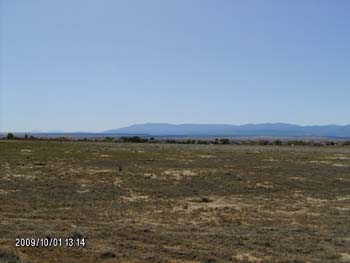
    A beautiful view in PW
    A beautiful view in PW

    To be honest, I don’t know why anyone would want to live in PW.  Better view of the mountains?  Yes, I suppose.  But, the wind, the dust, the acre after acre of bleak prairie land, complete dependency on a car.  I’ve talked to many people who moved to the Pueblo area, decided to buy a new or newer home in PW and now regret it…a lot.  Growth in Pueblo West was fueled by the same mortgage credit bubble partially responsible for dismantling the economy in 2009.  Cheap land, easy credit, granite counter tops in an unsustainable location.  Sound familiar?  For me, it brings to mind stories of California’s foreclosure capitals, like Stockton or San Bernadino.  It was a mistake then to build new houses in the middle of a barren wind-swept prairie, and it doesn’t make any more sense now.

    Now, I have wonderful friends who live in Pueblo West.  I don’t love them any less.  But, I do wish they would move into Pueblo and help the rest of us build a great city rather than following the failed example of sprawl that has hollowed out too many urban neighborhoods and weakened too many great cities.   Let’s follow a different course in Pueblo.  Let’s encourage walkability, a sense of place and a strong community.  Let’s discourage Southern California style urban sprawl and the resulting formation of neighbor-less neighborhoods and a car-dependent culture.

    Come on, Pueblo.  Let’s fund our important cultural institutions.  But, let’s do so in a way that will strengthen the core of the city.

    —

    Here’s an image of the Chieftain’s Opinion page display.  I like the US 50 graphic.

    chieftain-opinion
    Share:
    More
    • 13 years ago
    • Education
    • Featured
    • Geography
    • Justin
    • geography
    • graduate degree
    • graduate programs
    • graduate school
    • PhD
    • rankings

    2013 Geography Graduate Program Rankings

    About a year ago I posted a ranking of top geography programs based on the NRC survey of U.S. doctoral programs.  There were some complaints about the rankings, which I suppose is inevitable.  Some expressed concern simply because their program of choice wasn’t included.  But, a more legitimate thread of concern came from those who worried that programs focused heavily on Physical Geography were given greater weight by the NRC due to some advantages with grant funding.  In response, I created a survey and collected responses through 2012.  In addition, I collected data on the PhD granting institution of current tenure-track professors and normalized by size of program in terms of number of full-time faculty.  Then, I combined these three criteria and compiled a new set of program rankings.

    [highlight color=”options: yellow, black”]I have now produced 2014 GIS Graduate Program Rankings and, more recently, 2015 Top Graduate Programs for Spatial Careers . Please check out these newer rankings! [/highlight]

    Unlike the previous rankings, for which I could blame the NRC for any problems, these rankings are all my own and I take full responsibility for leaving your favorite program off the list.  You can post your displeasure in the comments section below.  Note, however, that programs that do not offer a PhD in geography were excluded from consideration.  Also, please note the following caution for prospective graduate students copied from the 2012 rankings post: selecting a graduate program is an individual decision and the top programs listed here may not be the best program for you.

    So, without further ado, here are my 2013 rankings of top Geography Graduate Programs.

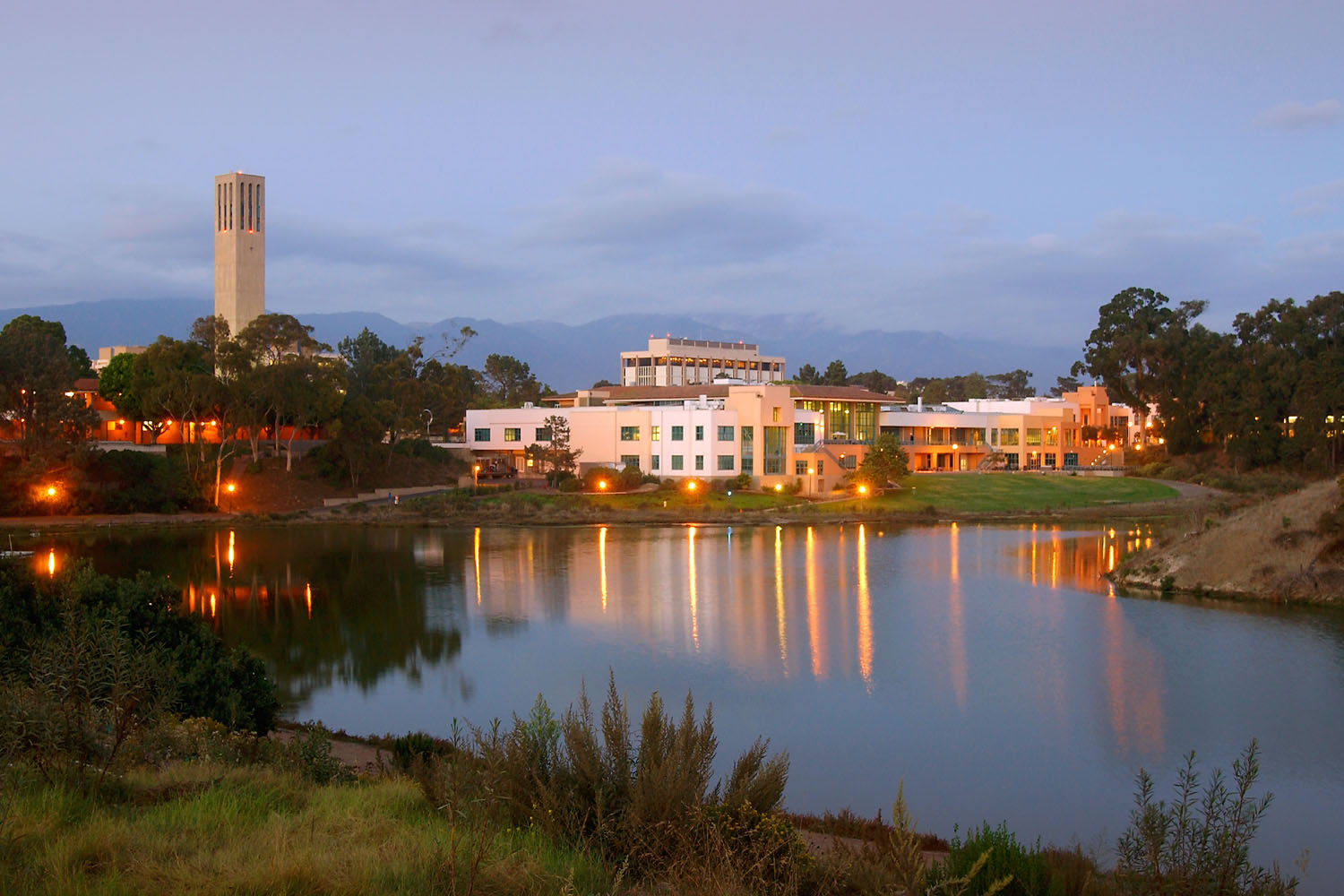
    1. UC Santa Barbara  http://www.geog.ucsb.edu/
    2. Colorado  http://www.colorado.edu/geography/
    3. Penn State  http://www.geog.psu.edu/grad/
    4. Ohio State  http://www.geography.ohio-state.edu/
    5. Wisconsin  http://www.geography.wisc.edu
    6. UCLA  http://www.geog.ucla.edu/
    7. Clark  http://www.clarku.edu/departments/geography/
    8. Boston University http://geography.bu.edu/
    9. Oregon http://geography.uoregon.edu/
    10. UC Berkeley http://geography.berkeley.edu
    11. Arizona State http://geography.asu.edu/
    12. Washington http://depts.washington.edu/geog
    13. Maryland http://www.geog.umd.edu/
    14. Illinois http://www.geog.uiuc.edu
    15. Minnesota http://www.geog.umn.edu
    16. SUNY Buffalo http://www.geog.buffalo.edu/
    17. Arizona http://geog.arizona.edu
    18. North Carolina http://www.unc.edu/depts/geog/
    19. South Carolina http://www.cas.sc.edu/geog/
    20. Syracuse http://www.maxwell.syr.edu/geo

    Honorable mention: Iowa, Georgia, Oregon State, Michigan State, Indiana, Kentucky, Texas, Kansas

    I look forward to hearing your thoughts and comments.  If you would like to have your opinion on top programs included in future rankings please complete this survey: https://www.surveymonkey.com/s/SG75772

    Share:
    More
    • 13 years ago
    • Pueblo
    • Justin
    • crime
    • map
    • pueblo
    • Robbery

    Criminals Target Stores with Easy Access to Major Arteries

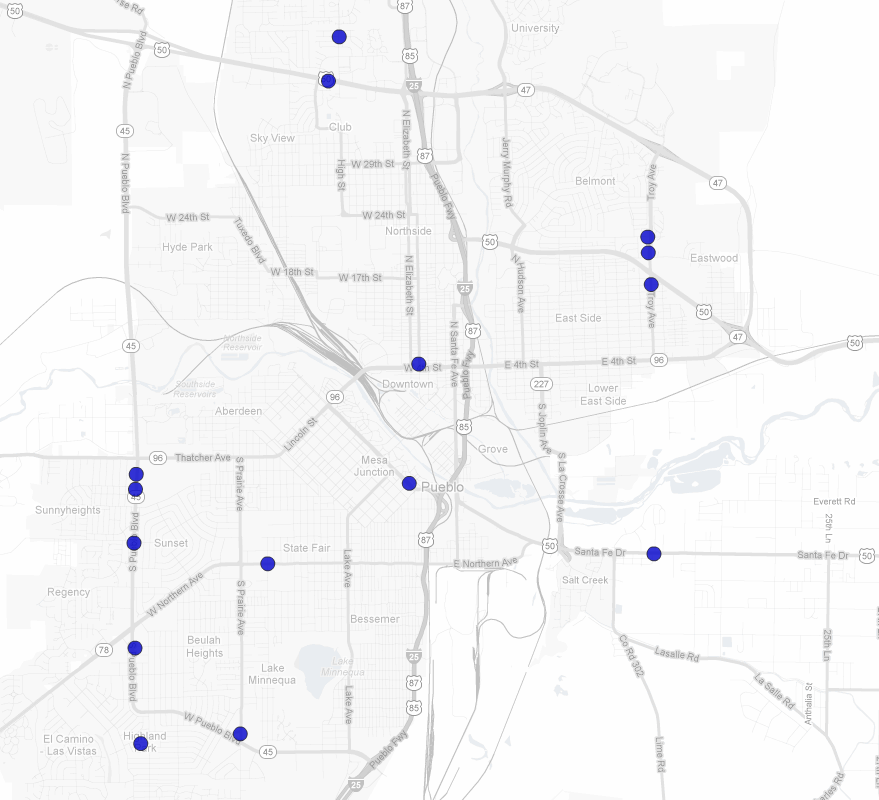
    Here’s a map of the 15 robberies that have occurred in Pueblo over the course of the past 3 weeks.  The map would suggest that criminals are targeting store locations with easy access to major transportation arteries including Pueblo Blvd., I-25 and US-50.

    PuebloCrimeSpreeMap


    Data sources: list of robbery locations was found posted on David Ortiviz’s Facebook page; map produced using MarketSeer, which utilizes Google Maps.

    Share:
    More
    • 13 years ago
    • Uncategorized
    • Justin

    Top Posts of 2012

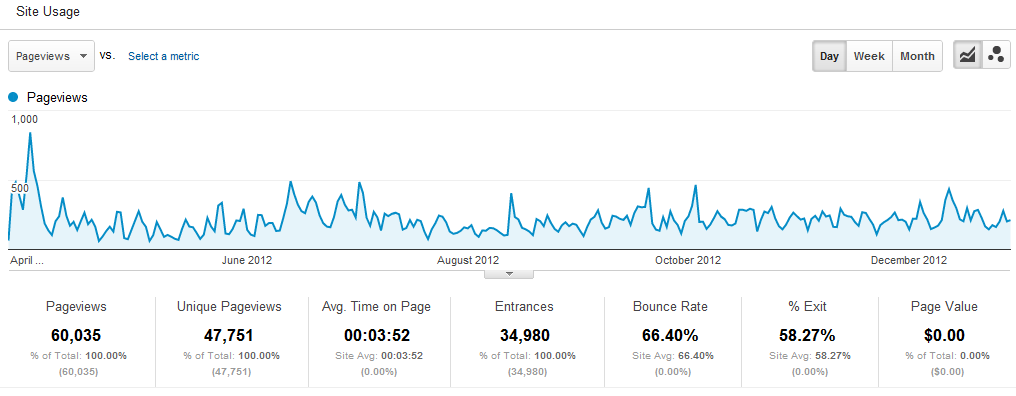
    2012 was my first year as a blogger.  I learned a ton, met lots of people and had a lot of fun along the way.  As I close out the year and prepare to keep things rolling in 2013 I thought it would be a good time to review my top posts for 2012.

    traffic2012

    Here are the top 10 in David Letterman like reverse order:

    10. Terrible map by Duke Climate Researchers.  I had to call out these researchers for failing to even think about basic geography concepts when producing their temperature change map.  The map by the National Cancer Institute attempting to illustrate melanoma risk is probably even worse.

    9. Academic Peer Review.  The academic peer review and research publication process is completely obsolete so I felt compelled to add some satirical commentary on my view of the process.

    8. Map of American Cultural Ecoregions.  This is a recent post that has generated lots of interest, especially on LinkedIn.  I plan to continue developing this concept in 2013.

    7. High fire risk in Colorado.  The Waldo Canyon fire near Colorado Springs was a big story this year, along with the incredible heat wave all across the US.

    6. Top 25 sunny places.  I was surprised at how much sunshine we receive in Southern Colorado and wanted to identify other places with lots of sunshine and relatively low housing costs.

    5. Banks are destroying America’s neighborhoods. As a real estate investor it became painfully clear to me this year that banks have exacerbated and prolonged the housing crisis that began in 2008.  This post was mentioned by an editor on LinkedIn and during one day I received over 2,000 page views, my biggest traffic day of the year.

    4. Why Pueblo.  I moved my family to Pueblo, Colorado earlier this year and in this post I make the case for Pueblo as a truly extraordinary bargain for people looking for a great place to live as a telecommuter or retiree.

    3. Geography visualization in business.  I make a case for increasing the use of geographical data analysis and visualization in business.  I also argue in a separate post that geospatial has a place in business schools.

    2. Spatial Career Series.  My series of posts on spatial careers generated plenty of interest.  I heard from a number of young people who were grateful for a different perspective and private sector guidance that seems to be generally lacking in most colleges and universities.

    1. Top Geography Programs.  My most popular post this year was definitely my ranking of the best Geography graduate programs in the U.S.  I plan to publish a new and updated ranking with improved methodology in 2013.

    A big THANK YOU to everyone who read and commented on my blog in 2012.  I hope I can improve in 2013.  Please let me know if you have any ideas for posts or suggestions for improvement.

    Best wishes for a Happy New Year!

    Share:
    More
    • 13 years ago
    • Business
    • Featured
    • Geography
    • Justin
    • analytics
    • big data
    • geography
    • visualization

    The Geography of Big Data: How to Get Started

    If you’re a business executive you’ve no doubt heard a lot about “Big Data” and the promise of analytics. You may have even read a recent post in the Harvard Business Review about how to Get Started with Big Data.  It’s a great article and offers good advice but probably should be retitled: “How to Get Started with Big Data if you Can Afford to Pay McKinsey & Co Consulting Rates“.  It sort of skips past the Big Data 101 issues that I see as first steps and moves directly to what I would consider more advanced uses of Big Data.

    Instead, let’s assume that your company isn’t a Fortune 500 company and maybe you’ve struggled a bit with technology strategy and operations.  Maybe you’re still struggling but you can’t wait another year for IT to complete the decade long SAP/Oracle/Cognos/Any ERP implementation that cost millions and has yet to show any benefit.  Perhaps you’re not a math genius, not a finance person and not even really what some might consider tech-savvy. But, you know your business, you know your customers and you know your products.  You also know you have to keep up with changes in your industry and you don’t want to be left behind if Big Data is the next big thing. [And, I definitely think it will be, at least one of them.]  You may be asking: where should I start?

    My advice: make a map.

    Huh? Why would I start by making a map?  Our company manufactures sophisticated engine components.  I need performance metrics, fancy algorithms and cutting-edge insights to drive strategy and profit. How is a simple map going to help me improve the bottom line? Sounds like a silly kindergarten activity with no possible ROI.

    Well, give me a chance to explain.  Before you can turn some Nate Silver-like econometrics modeling guru or Physics PhD genius loose you need good data and some ideas about what specific problems you want to try to address with analytics.  Producing a map can be an excellent process for moving toward a more sophisticated Big Data program.  So, how can making a map help start this process?

    Here are 6 benefits of making a map:

    1. Your company will be forced to take inventory of key data elements.
    2. Your IT team will be required to deliver data in a usable format.
    3. Any problems with customer data will become readily apparent in the geocoding process.
    4. Geographic representations of company data will reveal new patterns that spreadsheets may be disguising.
    5. Producing a map will allow everyone to get involved, not just the same old digit heads.
    6. Seeing your company’s data on a map will generate new ideas.

    In the coming days and weeks I will elaborate on each of these points. Stay tuned!

    Share:
    More
    • 13 years ago
    • Automotive Aftermarket
    • Business
    • Predictive Analytics
    • Justin
    • aftermarket
    • analytics
    • automotive

    Miles Driven Forecasting: Not So Fast My Friend

    When it comes to forecasting the future I like to think of two quotes from one of the smartest people I’ve ever worked with (the quote may not be precise but hopefully you’ll get the idea).

    1. Forecasts are always wrong.
    2. Forecasts with longer time horizons are always worse.

    David Simchi-Levi, brilliant MIT Professor and my former boss at LogicTools (now part of IBM), told me this in person and I’m pretty sure he’s expressed the same idea in one or more of his many now-famous supply chain related publications.

    I thought of these quotes immediately when I read a special report published in November by the Automotive Aftermarket Supply Association titled, “Don’t Discount Miles Driven in Long Term Forecasts”.

    In the article author Paul McCarthy argues that miles driven is a critical driver of demand for parts in the automotive aftermarket. And, while he acknowledges that miles driven has been flat or declining for the past several years, he points to the US Energy Information Administration (EIA) forecast for increased miles traveled as reason to look forward to positive future growth in the aftermarket.

    Well, I hate to burst anyone’s bubble but I have to point out that no one should hang their hat on this growth projection. If I was running a manufacturing or distribution company supplying parts to the automotive aftermarket I certainly wouldn’t put any stock in this forecast and I definitely wouldn’t make any capital investments based on these numbers. Let’s take a closer look at the EIA projections.

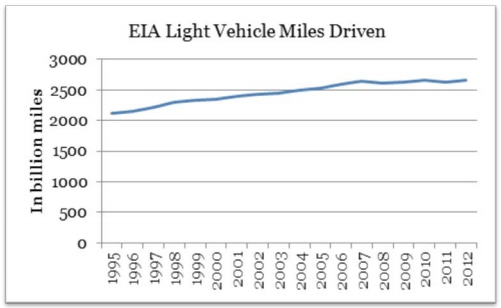
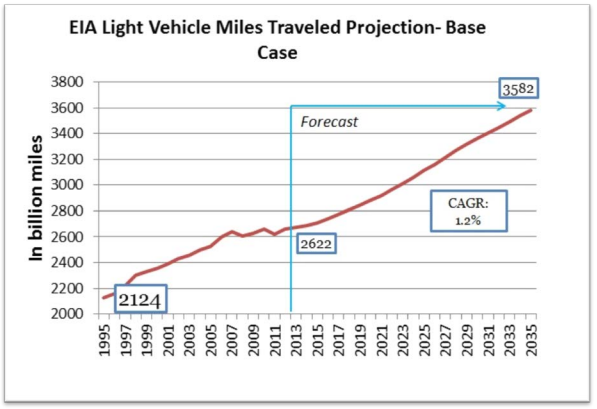
    According to the first chart (above) in the AASA report miles driven peaked around 2006-2007 (which makes sense) around 2700 billion miles and has been more or less flat since (also makes sense).  But, the “good news” in the second chart is that miles driven will increase sharply adding about 1 trillion miles annually in the coming years.  Well, when exactly will those additional miles start hitting the pavement?  According to the second chart in the report (below) it looks like it will be real soon, like next year or the year after.

    Great news!  Let’s get ready for big sales numbers!  Better ramp up production and stock more inventory!

    Uhhh…in the immortal words of Lee Corso, “not so fast, my friend”.

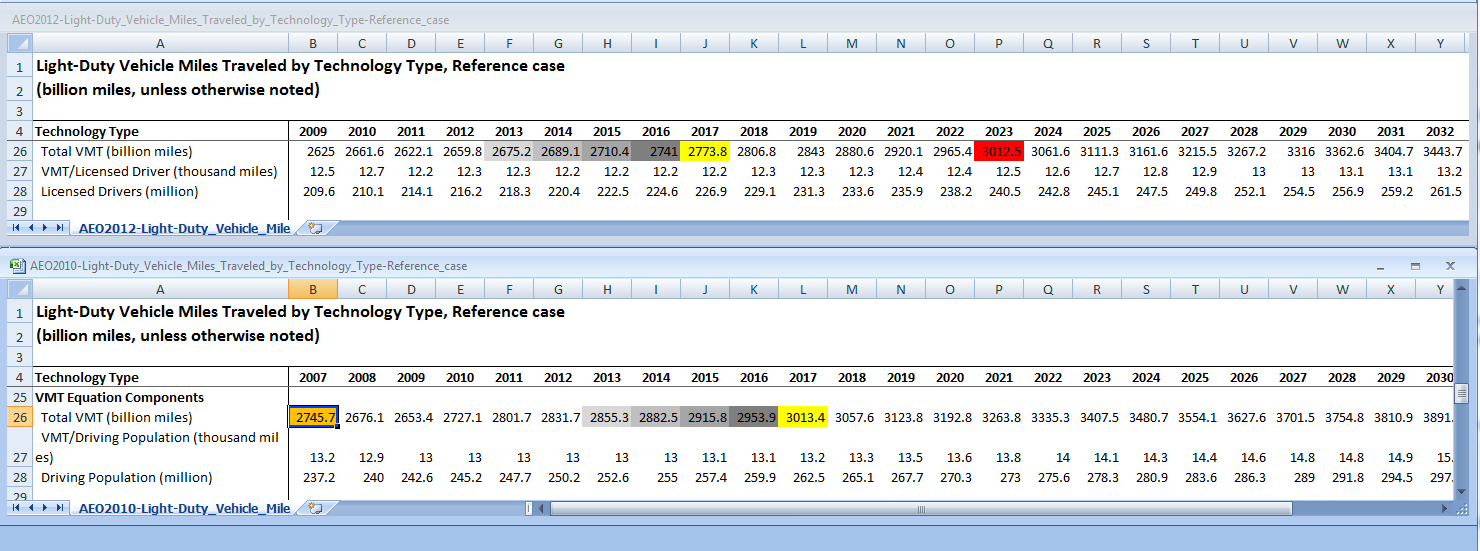
    When I looked closely at the EIA numbers I noticed a few things that might be a problem if you’re banking on total miles driven to be a growth driver for the aftermarket.  If you look at the graphic below (click on it for a larger, easier to read version) you’ll see the EIA’s 2012 forecast on top and their 2010 forecast on bottom.  I’ve shaded the forecast “Total VMT” for the next 5 years (2013-2017) in both charts for easier comparison.  You’ll notice that in the 2012 numbers we aren’t expected to return to the peak VMT levels reached in 2007 (orange highlight) until 2017.   You’ll also notice that between 2010 and 2012 the EIA moved their forecast date for reaching 3,000 billion miles from 2017 all the way back to 2023 (red highlight).  No big deal – just an extra 6 years!  That’s a lifetime in business.

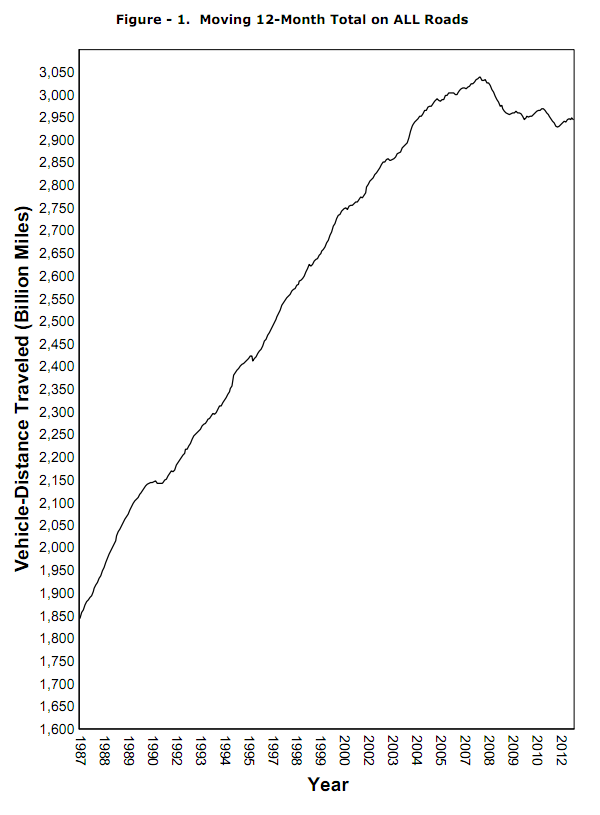
    The Federal Highway Administration also publishes a traffic volume report.  Here’s a link to the September 2012 report.  The chart below is on page 9 of the report and shows that miles driven has decreased since 2007 and is still in a downward trend.  If you were a stock-trading chart reader I think you’d say that the upward trend that started as late as 1987 has clearly been broken.  Miles driven could certainly go up from here but, as they say, “the trend is your friend” and it appears just as likely to me that they may be headed further south.

    I don’t know why anyone would want to predict something like total miles traveled in 2035.  What if we aren’t even driving cars in 20 years?  Think about all the change we’ve seen just in the past 5 years.  Do you think that Research in Motion may have been predicting growth in smart phones but failed to foresee the emergence of the iPhone and iPad?  I’ve read that Google is working on self-driving cars.  How will that change the way we transport ourselves?  Will improvements in navigational efficiency thanks to ubiquitous mobile devices with GPS technology lead to a large reduction in miles driven?  Will personal airplanes become economically viable in the next 15 years?  Will communication technology continue to advance at such an amazing pace that virtual meetings become a far more reliable means of interaction allowing far more people to work from a home office?  Or might it allow more people to shop or visit service providers (e.g., doctors, lawyers, psychologists, teachers, etc) in a virtual environment?

    It’s way too difficult to predict that far out into the future.  That’s why I prefer to look no further than 1-2 years out for business forecasting.  Will miles driven increase in the next year or two?  Perhaps but probably not by much.  Will miles driven decrease in the next year or two?  Perhaps but probably not by much.  Will cars still be the primary mode of transport in 2 years?  Yes.  There you go.  Three forecasts you can hang your hat on.  Obviously those forecasts aren’t worth much.  But, I would consider paying good money for a forecast of miles driven in Q1 and Q2 2013, especially if it were available by region.

    So don’t worry about how many miles will be driven in 2015, let alone 2025 or 2035.  No one really knows for sure.   I can only safely guarantee two things:

    1. The forecasts will be wrong.
    2. The forecasts with the longer time horizons will be worse.


    Share:
    More
    • 13 years ago
    • Featured
    • Geography
    • Justin
    • cartography
    • geography
    • regions
    • segmentation

    A New American Geography: Cultural Ecoregions for Consumer Segmentation

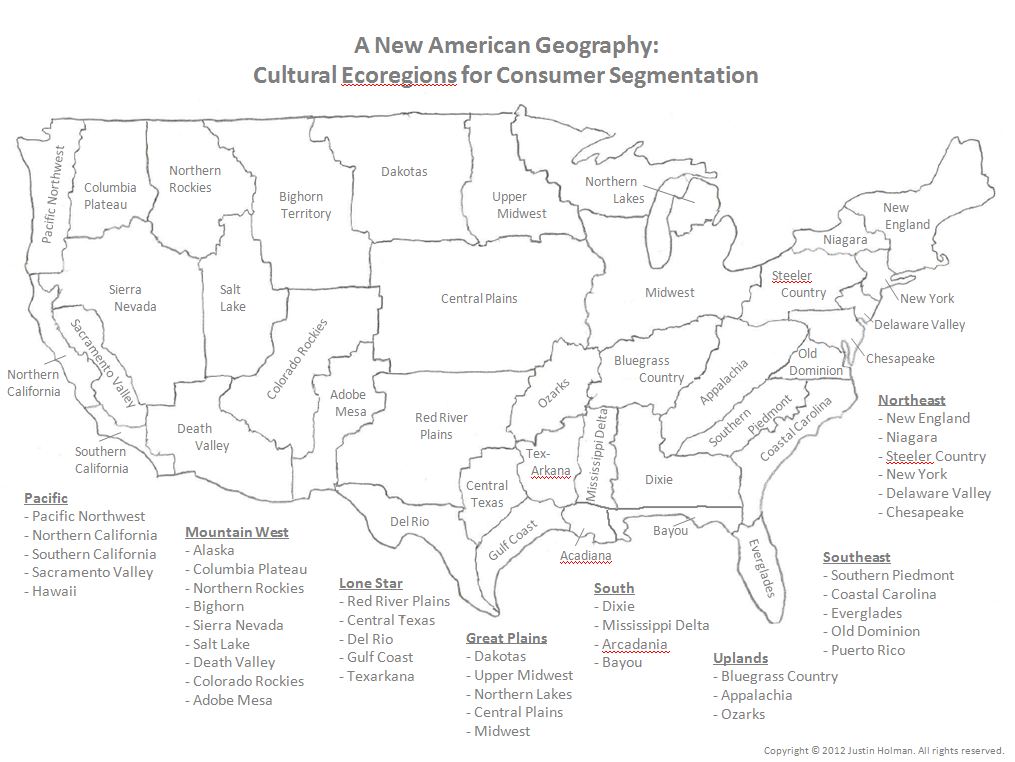
    I’d like to introduce my first pass at a new American Geography with regional definitions based on common culture, climate and environment rather than political borders.

    I started this project because I needed a better way to define different American regions so I can help my clients, who supply or distribute goods in the US, better understand how to “cluster” their store locations and their customers.  Demographic segmentation systems have become a popular tool for analysis of customer data to make retail location decisions; they’re also quite useful in a variety of other marketing strategy campaigns.  I’ve used these data to build sales forecasting models and while they certainly are effective for identifying locations with similar socioeconomic status they don’t usually take into consideration environment/climate or unique cultural attributes that exist in different parts of the country.  This can be critical for certain types of consumer purchase behavior.  For example, if you’re in automotive, you know that consumers on the West Coast and the East Coast are far more likely to buy foreign name plates rather than domestic vehicles.  You also know that 4-wheel drive vehicles are going to sell better in locations with more snow or with uneven topography.  So clustering consumers by income variables doesn’t really capture the many differences in purchase patterns for companies selling cars, car parts or services related to specific vehicle types.  Same goes for home improvement and many other consumer products industries.  Should Home Depot and Lowes stock the same garden supplies at the same time in all parts of the country?  Of course not.

    Another problem is the use of political boundaries.  Often the most granular location information for model development is State of residence.  For example, in building replacement rate models for particular car part categories we’ve made model bias adjustments at the State level due to limitations in the available survey data.  This is certainly better than using Census regions or divisions but still falls short when it comes to large states like California, Texas, Florida…even Oregon, Washington, Colorado, Illinois.  The problem is that there often exist clear cultural and/or environmental differences within a particular state that need to be considered.  Let’s say you run a chain of stores that sell tires, like Discount Tire, Les Schwab or even WalMart.  Do you really want to stock all stores in California with the same inventory assortment, fitting the same profile of vehicles?  Something tells me that you’re likely to find a pretty different proportion of Toyota Prius models in Truckee vs Tustin.  Do you think there may be a few more Ford F-150 pickup trucks in Modesto vs Mill Valley?

    So, I’ve tried my best to come up with a set of regions that can be used for these types of analytical endeavors and, perhaps, they can be used to help better understand America’s unique cultural landscape.  My colleague and fellow geographer, Steve Scobie, and I started by defining our own set of regions and then comparing – our own little “double blind” study.  From that we came up with some shared boundaries and now I’ve taken it a bit further with some modifications and a set of names to go with each region.  I’ve also created a set of 8 divisions to group the regions when a smaller number of regions is needed.

    I would love to get some feedback on this.  I know the Western US fairly well, I’ve lived in the Midwest and I’ve traveled to most parts of the country but there are plenty of areas that I don’t know that well including most of the South and the Northeast.  If you see a boundary that doesn’t make sense to you I would really like to hear what you don’t like and how you might change it.  I would also love to hear thoughts on the region names.  Steve contributed several but I’ll take blame for any that seem incorrect or inappropriate.  My apologies in advance for any place names that someone may find offensive.  I’m sure there are better names out there.  I’m especially interested in names that are already in use by people living in or near the region.  But please don’t submit names with any sort of negative connotation.

    Please share your thoughts in the comments section below.  Thanks!

    By the way, I had so much fun making this map.  It was produced “old school” by tracing an outline of the “Lower 48” and then using a variety of maps (political, environmental, topographic, demographic) to select boundaries and draw/trace them by hand.  Takes me back to Cartography 101 with the legend of Oregon cartography, Bill Loy; now gone but not forgotten.

    Share:
    More
    • 13 years ago
    • Uncategorized
    • Justin
    • election
    • Obama
    • partisan
    • President
    • presidential
    • Romney
    • Vice President

    Ending the Civil Cold War: Two Ideas for Moving Past a Partisan Democracy

    Like many Americans I’ve been following the Presidential election cycle fairly closely.  Also, like many Americans, I find the tone and tenor of current politics nearly unbearable.  In my lifetime there’s been a noticeable shift away from doing what’s best for the country and toward doing what will help one of the two political parties achieve greater power.  The system is broken and I think more time should be spent fixing the system rather than fighting over who deserves tax cuts and who deserves government benefits.  I don’t like to complain about a situation without also offering a solution.  So, here’s my proposal to help move our country beyond partisanship and toward a more effective democracy.

    I contend that the election system itself is driving the trend toward polarization and deeply partisan politics.  We have a winner take all Presidential system that leaves nearly half the country angry at the end of each term.  And, we have a party nomination system that often produces extreme candidates who “appeal to the base” of angry voters who tend to be further removed from the center (and, often, reality).  Everyone seems to know that candidates have to campaign by moving far to the right or left during the nomination process and then by veering to the center during the general election.  I believe that if we fix these broken pieces of the electoral puzzle we will find ourselves solving more of our problems and less time debating and fighting over issues.  So, how can we fix the electoral system?

    First, we should eliminate re-elections at the Presidential level.  A President should be focused on doing what’s right for the country not on campaigning for re-election.  A new system should allow a President to govern and not allow the President to spend time on the campaign trail.

    Second, we should find a way to encourage the election of highly capable individuals who will help lead us to compromise and unification rather than ideologues who will create further polarization.

    Third, we need a system that doesn’t require hard stops every time the Oval Office changes hands.  The leadership transition should be seamless.  Along the same lines, we should have a system in place that guarantees a President won’t have to learn how to govern on the job.  The first 100 days of a Presidency shouldn’t involve a mad dash to demonstrate how different they will be and how their supporters will be rewarded.  Rather, the first 100 days should demonstrate, almost effortlessly, that a new administration will continue to lead America in a consistently competent manner assuring financial markets and world leaders, not to mention ordinary citizens, that they need not be concerned about surprise overnight changes in policy.

    So, how do we address these problem?  Here’s my plan in 2 relatively simple steps.

    1. Instead of electing or re-electing a President every 4 years, let’s elect a Vice President.  This person will serve 4 years as VP and then 4 years as President.  The individual would be guaranteed an 8-year term to cement a legacy of doing what’s best for the country without fear of retribution in an upcoming election.  At the end of 8 years, they would no longer be eligible to hold public office.  This would elevate the position of Vice President (currently a fairly limited role) and guarantee hands-on training for anyone who would become President.  Let’s say that instead of choosing Obama or Romney, we simply agree that Romney will become the new VP.  Obama will continue as President for the next 4 years and Romney will become President in 2016.  Instead of a whole new cycle beginning in 2014 to elect a new President, everyone will know that Romney will be President and the electorate will begin to choose who will become Vice President in 2016 and ultimately President in 2020.  This would end Presidential re-election campaigns and allow the sitting President to focus exclusively on the business of running the country and making meaningful progress on tough issues. This system would also ensure a far more smooth transition each 4 years.  Rather than knowing who will be President 3 months in advance we’ll know 4 years in advance.

    The VP role would become far more important.  Perhaps the office of the VP would be primarily tasked with setting the agenda – submitting budget and policy proposals and negotiating with congress. This would free the office of the President to focus on executive management of the country, both internationally and domestically. The President would retain veto power but would no longer be required to spend huge chunks of time on policy debate. Instead the focus would be on making decisions and reacting to challenges and crises.  Imagine if Obama was able to stay focused on managing his Cabinet officials, containing political unrest in the Middle East, negotiating trade policy with China and fighting the housing and jobs crisis instead of traveling to swing states, raising money and giving stump speeches or preparing for debates.   I suspect his job approval ratings would skyrocket.  There’s a good model for this at most large corporations where you typically see a CEO and a strong Chief Operating Officer (COO) at the helm with the COO poised to assume CEO responsibilities when the time comes.

    2. We need to dramatically change the nomination system.  Rather than selecting 1 nominee for each party, the primary process should produce up to 3 nominees from each party (presumably 3 Republicans, 3 Democrats and a handful of independents, perhaps a libertarian, a green party candidate, etc – a minimum number of signatures on a petition or primary votes would be needed to get on the ballot).  The general election would then require a 2-step process. Step 1 would be a “Super Primary” in which all voters are eligible to decide on which 2 candidates should face one another in a run-off. Voters would be permitted to select 2 candidates instead of just one. The top 2 vote getters would then face-off before Step 2, a final vote where a winner would be selected in the traditional electoral college approach.

    The benefit of this approach would be that extreme candidates on either end of the political spectrum would have a more difficult path to winning the nomination and more moderate candidates would likely receive votes as many people’s “runner up” choice. Would Rick Santorum be likely to make it to the run-off?  How about Sarah Palin?  Would George W. Bush or Barack Obama have been elected?  Would Dick Cheney have been Vice President?  My guess is no to all five.  Candidates would no longer need to pander to the extreme elements within their party because moderate positions would become more attractive to voters in the Super Primary.  In addition, VPs would know that they’ll be required to cooperate with the President.  This would help unify the country and lead to more policy compromise.

    How would this have played out assuming the system was in place beginning in 2000?  I think Al Gore would have served as President with John McCain as his VP.  John McCain then would have taken office in 2004 perhaps with VP Wesley Clark.  Wesley Clark takes the helm in 2008 with VP Hillary Clinton and currently we’d have President Hillary Clinton and about to elect VP Mitt Romney.  Obviously this is complete speculation.  Who knows what would really happen.  But, we would be *highly* unlikely to see the likes of Sarah Palin or Dick Cheney in line for the Presidency.  We would also see more moderates entering the fray and 3rd party candidates getting a  more level playing field.  All of that, in my opinion, would be a terrific step forward for America.

    These ideas may not be the ideal solution – I’m no political scientist – but something will have to give and I’d rather not see us continue the Civil Cold War that we have today…or worse, see it escalate into civil unrest and violence.  I guarantee that no one with power to wield in the GOP or the DNC will embrace these ideas.  They have too much to lose if the status quo goes away.  Change will have to come from a groundswell of grassroots support.  As citizens we have that power.  So, if you like these ideas, please share, retweet, mark as favorite, etc.  If you don’t like these ideas, please propose your own thoughts and share them or comment below and suggest changes that would lead to improvement.

    I feel like America has become the equivalent of a “job-hopper”, someone who is always looking for a new gig (or policy portfolio) and never focusing on the job they’re being paid to do.

    Let’s end the Civil Cold War. Let’s move past extreme partisanship. Let’s stop job-hopping.  Let’s get back to work.

    Share:
    More
    • 14 years ago
    • Automotive Aftermarket
    • Justin
    • aftermarket
    • analytics
    • automotive
    • demand
    • forecasting

    Blogging Elsewhere — Estimating Category Market Demand in the Automotive Aftermarket

    Recently I published an article on the Aftermarket Analytics company blog, on how we estimate market demand. Check out the excerpt below, and click here to read the full post!

    “Until recently the Automotive Aftermarket was provided data from key channel distributors indicating monthly sales activity and market share for various vehicle part categories. At the beginning of 2012 the consortium of companies that provided these data collapsed. Since then, parts suppliers and others in the Aftermarket have been searching for a new source of data to fill the void and this very issue is being discussed by industry representatives at the AAIA Fall Leadership Days conference in San Francisco this week.

    In this post I propose a methodology for estimating market size and discuss how this estimate of total demand can form the basis for replacing, and perhaps improving upon, the market data previously provided by NPD.

    The two key elements in producing category market size estimates are (1) vehicle registration data (referred to typically as VIO, i.e., vehicles in operation) and (2) Replacement Rates.

    VIO data is available at various levels of geography (US, State, County, ZIP, Censust tract, and block group) and provided by Experian and Polk. This data is expensive but easy to acquire and utilize.”

    Share:
    More

    Posts pagination

    1 … 10 11 12 … 17

    Archives

    Popular Posts

    • Why Relocate to Pueblo Colorado
    • The 3 Lessons I Learned After Accidentally Buying a Liquor Store
    • 2014 Rankings - Top 10 Graduate GIS Programs
    • 2015 Rankings - Top Graduate Geography Programs for Spatial Careers
    • 2017 Geography Graduate Program Rankings

    Recent Posts

    • An Ode to My Students
    • Forecasting Confirmed COVID-19 Cases
    • Climate Anomalies and Aftermarket Part Sales
    • Weather and Climate Data for the Automotive Aftermarket
    • Technology Jobs in Pueblo

    Recent Comments

    • Joe on Lesson 2: World Regions and Theories of Uneven Economic Development
    • Justin on Pueblo Neighborhoods 1.0
    • Raj on The 3 Lessons I Learned After Accidentally Buying a Liquor Store
    • Maggie on Pueblo Neighborhoods 1.0
    • Justin on Pueblo Neighborhoods 1.0

    © Geographical Perspectives, 2017

    Site Managed by Gecko Designs

    Forget password?

    What are you looking for?