Geographical Perspectives
    • Home
    • Geography
    • Pueblo
    • Teaching
    • About
    • Aftermarket Analytics
    • 11 years ago
    • Education
    • Geography
    • Justin
    • Area Studies
    • cartography
    • GIS

    Can you combine GIS/Cartography with Area Studies?

    Dear Justin,

    I’m hoping you could give me some advice! I’m an undergrad studying Turkey. I’ve been building up a double major in Computer Science but I really don’t enjoy programming to any huge extent. I don’t want to be a software engineer. I like the skills, just not the end goal. My advisor has recommended that I segue off into something like GIS and Cartography because I’ve focused my CS classes on visualizing data. I have the chance to take geography courses at a school in my consortium, but I have no expert at my school to talk to about where that might lead. That’s why I’m messaging you, though I understand if you’re busy or don’t want to respond!

    I have two questions if you do have the time:

    1. I’m really interested in Human Geography as it applies to area studies. This statistical blending of social sciences and maps to better understand human phenomenon is fascinating. I don’t know if that means I want to study historical GIS, cultural geography, religious geography or what, but I do know that if I were to study geography it would be through the lens of the Turkey and through the medium of visualizing data. Is it possible, do you think, to focus geography in that way? On an area of the world? And while it seems like many human geographers do so, could something like that with the proper statistical and spatial background lead into Geospatial Analysis instead of purely human geography research or teaching positions?

    2. What is a good way of getting a feel for what types of Geography fields I like? Do you recommend any specific books or courses? I have the time to devote a year or so to Geography classes and I have both technical (GIS/Statistics/Remote Sensing/Cartography) and Human/Physical geography courses available to me. I just feel like there’s so much I don’t know and no one to ask, so I have to do the legwork on my own. Any advice on how to start that process would be really appreciated!

    Thank you for your time, and the resource of your blog!

    Sincerely,
    M.

    Dear M.,

    I like what you’re doing and where you’re headed. Turkey is a fascinating place with an incredibly important strategic location. And it will make for a superb lens through which to make sense of a variety of topics in human geography, economics, intl relations, etc.

    I would keep going with the cs degree. It will open lots of doors. And dont worry. You won’t be stuck working as a software engineer your whole career. Or even for one day if you prefer not to. You’ll also avoid the unemployment line and your parents basement.

    Yes, you can focus on Turkey. There are many human geographers who specialize in a particular region. You will want to add some sort of thematic specialty if you continue along the academic route. So maybe economic/political geography or human-environment. But that can wait until grad school.

    As far as selecting geography classes don’t worry too much. Just take classes that seem interesting to you. Or take classes taught by the best professor(s). Visualization of data is the future in many fields so keep pushing to learn as much as possible.

    In today’s economy careers are created or discovered. Planning ahead for specific jobs no longer works unless you want to be a surgeon or a patent attorney etc. So just do your best to find things that fascinate you and learn everything you can about them. In 10 years you’ll look back with amazement as seemingly disparate experiences and formal study topics come together to make you perfect for a unique and dynamic (and probably lucrative) role in the economy.

    Wishing you the very best,
    Justin

    Share:
    More
    • 11 years ago
    • Education
    • Geography
    • Justin
    • esri
    • geography
    • GIS
    • graduate educatioin
    • mapping

    New Online Digital Mapping Program at Kentucky

    For blog readers considering an online GIS certificate or graduate degree, there’s a new program at the University of Kentucky worthy of consideration.

    Kentucky has become one of the most innovative Geography Departments in the US thanks in part to the pioneering work of Professor Matthew Zook and his devoted Floating Sheep research colleagues. They have successfully used open source mapping and web scraping technologies to develop interactive digital maps shedding new light on salient topics such as racism, religion, abortion and the price of marijuana.

    Kentucky’s new program provides an opportunity to learn these techniques directly from the masters. If this sounds good, check out the New Maps Plus program. The curriculum looks excellent (except for MAP 701 and MAP 719 which will feel like cult indoctrination or Sunday school with an alien vocabulary), similar to what’s offered at USC’s Spatial Sciences Institute, and part of a new breed of graduate programs focused more on the analysis of spatial data and less on ArcGIS button sequences. I expect this flavor of geography graduate education to continue growing while University sponsored ESRI software training programs continue down the path toward obsolescence.

    The program is in its infancy so there may be hurdles getting off the ground; but, I expect great things to come.

    Share:
    More
    • 11 years ago
    • Business
    • Justin
    • marijuana
    • market
    • usage estimate
    • Washington

    Marijuana Usage in Washington State

    In a recent posts I reviewed a research report estimating the size of the Colorado marijuana market and reported results from a survey attempting to determine the marijuana usage rate in Colorado. In this post I report results from an identical survey I ran in the State of Washington.

    The Washington survey results are fairly similar to the Colorado survey.

    Survey respondents believe, on average, the marijuana usage rate in Washington is 39% (versus 41% in Colorado).

    Here are some additional findings for comparison.

    In Colorado, females report +4% usage over males. In Washington, females report -2% usage vs males.

    Both States show a negative relationship between age and usage rate.

    And, both States show a negative relationship between income and usage rate.

    There doesn’t seem to be a significant gap between Urban, Suburban and Rural in either State. I expected Urban survey respondents to report higher usage rates in both States.

    Share:
    More
    • 11 years ago
    • Business
    • Justin
    • Colorado
    • marijuana
    • market
    • usage estimates

    Will Colorado’s True Marijuana Usage Rate Please Stand Up

    In my most recent post I looked at a study conducted by the Denver-based Marijuana Policy Group (MPG). They produced an estimate of the number of users in Colorado and an estimate of the total metric tons consumed in Colorado. I used their metric tons estimate to take a stab at the size of the marijuana market in Colorado. My estimate based on 130.3 metric tons consumed is $1.125 Billion for 2014.

    As part of the MPG report, which you can download here, an estimate of the total number of marijuana users in Colorado is produced. MPG’s estimate includes an under-reporting bias adjustment (22% for infrequent users and 11% for heavy users) based on a similar study conducted by the RAND Corporation. MPG’s final Colorado user estimate is 485k monthly users and 686k yearly users (rounded to nearest thousand). The population of Colorado residents 21 years of age or older is 3.7 million (rounded and based on Census figure of 3,677,243,243 for 2013). This translates into a Colorado marijuana usage rate of approximately 13.1% for monthly users and 18.5% for yearly users.

    These figures and the under reporting adjustment have a basis in the research literature but in reading both reports I began to wonder if there might be a better way.

    It occurs to me that one possibility for determining the Colorado marijuana user population is to survey residents asking them what portion of the population they believe uses marijuana. This allows respondents to make an estimate without concern about how the information might be used against them in the future. So I decided to run a Google Survey asking respondents to estimate % use of marijuana in their community.

    You can look into the details by following this link to my survey results.

    I posed only one question:

    “What percentage of people in your community use marijuana? Select an estimate between 0% and 100%.”

    Here’s a link to view the question as a respondent.

    Obviously the survey question has drawbacks. The most obvious is the word “community”. What does that mean? I like it because it allows the respondent to define the word on their own terms. Hopefully respondents were thinking about people they know well enough to have a pretty good idea whether they use marijuana or not. I doubt this would fly in the academic peer-review world. But that’s the beauty of blogging.

    Drawbacks aside, my survey respondents believe, on average, the Colorado marijuana usage rate is 41%. Quite a bit higher than the RAND and MPG estimates.

    Here are some other findings:

    Women estimate higher usage than men.

    Younger people estimate higher usage than older people. Duh.

    Lower income people estimate higher usage than higher income people. Note there were only 24 respondents with inferred incomes greater than $100,000, not a sufficient number to produce a reliable estimate.

    City dwellers estimate higher usage than suburban and rural residents. I expected a larger gap.

    Interesting results. If true, this would mean:

    • There are approximately 1.5 million marijuana users in Colorado.
    • The marijuana market in Colorado is approximately $2.5 Billion.
    • Legal sales represent only ~28% of the total market.
    • The black market is huge with ~$1.8 Billion in annual tax free sales.
    • Colorado is losing around $400-500 Million in annual tax revenue.
    • If all potential marijuana tax revenue was collected the amount would be in the same ballpark as total Corporate net income taxes collected in Colorado in 2013.

    Wow.

    What do you think?

    [yop_poll id=”5″]


    Share:
    More
    • 11 years ago
    • Business
    • Justin
    • Colorado
    • legalization
    • marijuana
    • tax revenue

    Colorado’s Missing Marijuana Tax Revenue

    I was talking with some real estate investors from Santa Fe, New Mexico recently. They are thinking about moving to and investing in Colorado. The topic of recreational marijuana came up along with the question: “How much tax revenue is being left on the table?”

    Good question.

    And it’s a difficult question to answer accurately. To answer we first need to know the size of the marijuana market. Not just the legal market but the entire market.

    Thankfully, one group of researchers made such an estimate for the State of Colorado and published their results about a year ago.

    The Marijuana Policy Group (MPG) was formed in 2014 as a collaborative effort between the University of Colorado Boulder Business Research Division (www.leeds.colorado.edu/brd) and BBC Research & Consulting (www.bbcresearch.com) in Denver. Both entities have offered custom economic, market, financial and policy research and consulting services for over 40 years. The MPG mission is to apply research methods rooted in economic theory and statistical applications to inform regulatory policy decisions in the rapidly growing legal medical and recreational marijuana markets.

    I was pleasantly surprised by the MPG publication’s readability and thorough methodology. My only complaint would be why not put forth an estimate in total dollars? Their final estimate for the size of the Colorado marijuana market is 130.3 metric tons in 2014. Note this estimate is for the adult, 21 years of age and older, market. It does not include any estimate of juvenile consumption.

    Okay, how do we estimate the size of the Colorado market in terms of US Dollars?

    Let’s start by converting metric tons to ounces. 1 metric ton = 35,273.9619 ounces. So, 130.3 metric tons = 4,596,197.23557 ounces. Let’s keep it simple and conservative and we’ll say 4.5 million ounces.

    The MPG study also estimates pricing per ounce to be in the $200-320 per ounce range. Medical marijuana sales are at the lower end of the scale. Retail sales in mountain communities are at the higher end of the scale. I’m guessing most retail purchases are far less than an ounce involving a higher per-ounce rate. Average prices for 1/8 of an ounce are about $40 according to coloradopotguide.com. Again, to keep it simple, let’s take an average of the low/high figures and round down to be conservative. So we’ll say the average price paid is approximately $250 per ounce.

    Multiplying we get a total market size estimate of approximately $1.125 Billion (2014).

    Righteous bucks, dude.

    I think the estimate will prove to be low. In any case, that puts marijuana in the same general ballpark as Colorado’s Aerospace industry.

    In 2014 we also know that Colorado reported regulated sales of retail and medical marijuana just shy of $700 million. This means Colorado is capturing approximately 62% of the total estimated marijuana market. Seems pretty good for the first year of legalization.

    It also means Colorado is missing out on approximately 38% of the potential revenue from taxes and fees. If we look only at the 10% State tax we’re talking about $70 million collected and $41 million left on the table. And that’s just one piece of the complicated tax puzzle. Millions more in local, excise and other taxes/fees are currently left uncollected with organized crime enjoying a nice slice of the unregulated action.

    Colorado needs to find a strategy to completely kill off the black market. Sooner the better.


    Share:
    More
    • 11 years ago
    • Automotive Aftermarket
    • Business
    • Predictive Analytics
    • Justin
    • aftermarket
    • big data
    • predictive analytics

    Speaking at the 2015 AASA Technology Conference

    Mark your calendars!

    I will be one of the featured speakers at the 2015 Automotive Aftermarket Suppliers Association Technology Conference.

    AASA-banner

    If you happen to be in Clearwater, Florida on September 22 stop by to say hello.

    Share:
    More
    • 11 years ago
    • Ecuador
    • Justin

    The Chilcapamba Community in Ecuador

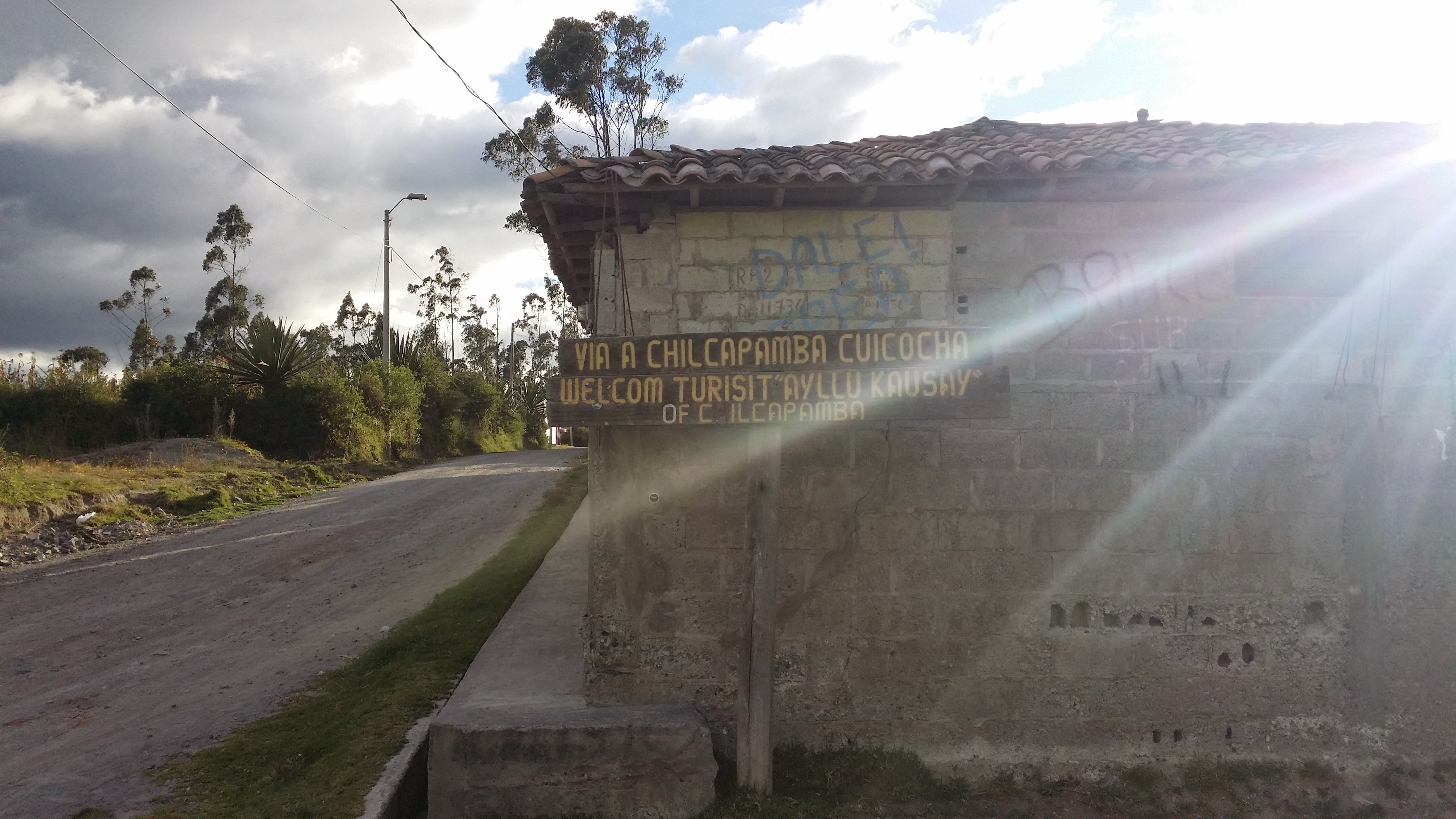
    After a week in Quito and a weekend in Otavalo I traveled to a small indigenous community about 30 minutes by car from Otavalo. The name of the community is Chilcapamba.

    chilcapamba-vista4

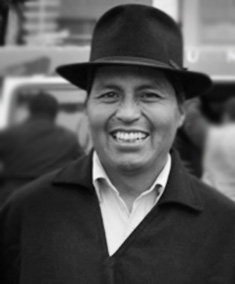
    I stayed with the leader of the community and his family. Alfonso and Francisca Morales operate a small guest lodge in Chilcapamba.

    alfonsomorales1
    Alfonso Morales

    Alfonso and Francisca provided a private room with private bathroom/shower. Certainly nothing fancy but I was very comfortable. The property included a pair of stucco buildings in a tranquil rural setting. The property was nearly self-sufficient; they raised chickens, pigs and guinea pigs (a delicacy in Ecuador) along with a vegetable garden and numerous fruit trees. The property included a cool MacGyver style water system with large barrels collecting rain water and connecting to a series of hoses guiding water to the house for general use and to the garden for irrigation.

    Here’s a video tour of the property.

    The setting of Chilcapamba is beautiful. Large cloud-shrouded green volcanoes dominate vistas in all directions. Most of the land is dedicated to agricultural production. Some small scale farms with a few acres of crops combined with cows grazing and pigs/chickens hunting about for a few bites of food. Some properties are larger haciendas, maybe 20-40 acres, with larger scale production. Flowers are a major export in Ecuador and large green houses can be seen along with larger herds of cattle and rows of corn. Nearby Cotacachi is a center for leather goods production so the cattle may be raised for both beef and leather.

    Here’s a video taken while walking from Quiroga (nearby town with bus service) to Chilcapamba.

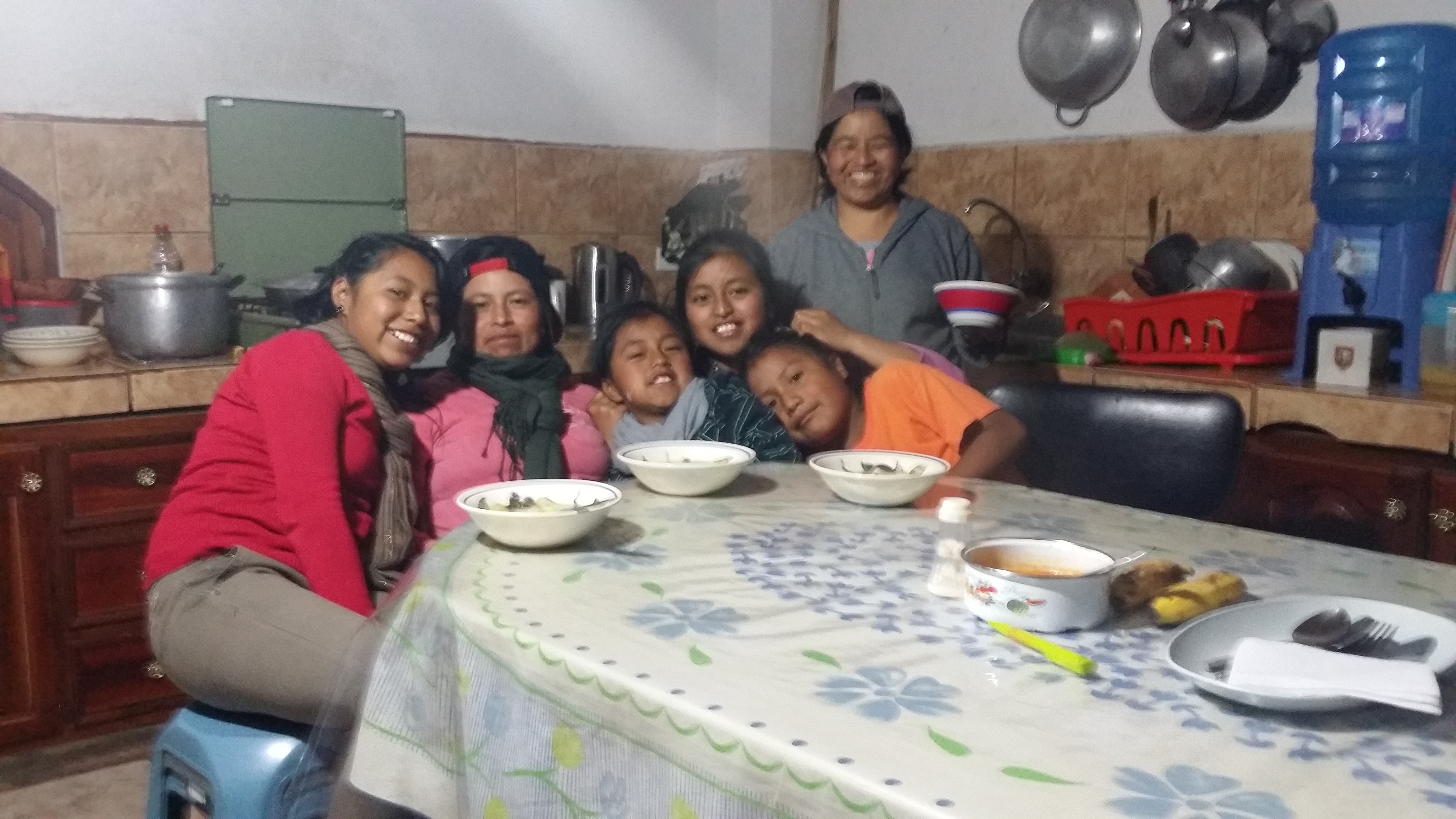
    Francisca prepared meals for the family and for me, served in their kitchen. For breakfast I was offered eggs and bread rolls with butter and fruit jelly along with coffee or tea. My one disappointment in Ecuador was coffee as it was typically served “instant” like combining hot water with cocoa mix for hot chocolate. Adequate but not nearly as pleasing as my regular mug of dark roast from Solar Roast. Breakfast also typically included fresh squeezed juice. For lunch we always started with a bowl of soup followed by a plate of rice with chicken, pork or beef and vegetables with an occasional green salad on the side. Again, fresh fruit juice is typical for dessert. Dinner is the same as lunch, more or less, and often consists of the same food leftover from lunch with a few different highlights.

    Morales Kitchen
    Kitchen of Francisca Morales (standing in back), her sister (2nd from left in hat), son Tupac (middle), daughter Consuela (4th from left) and her niece (far left) and nephew (far right).
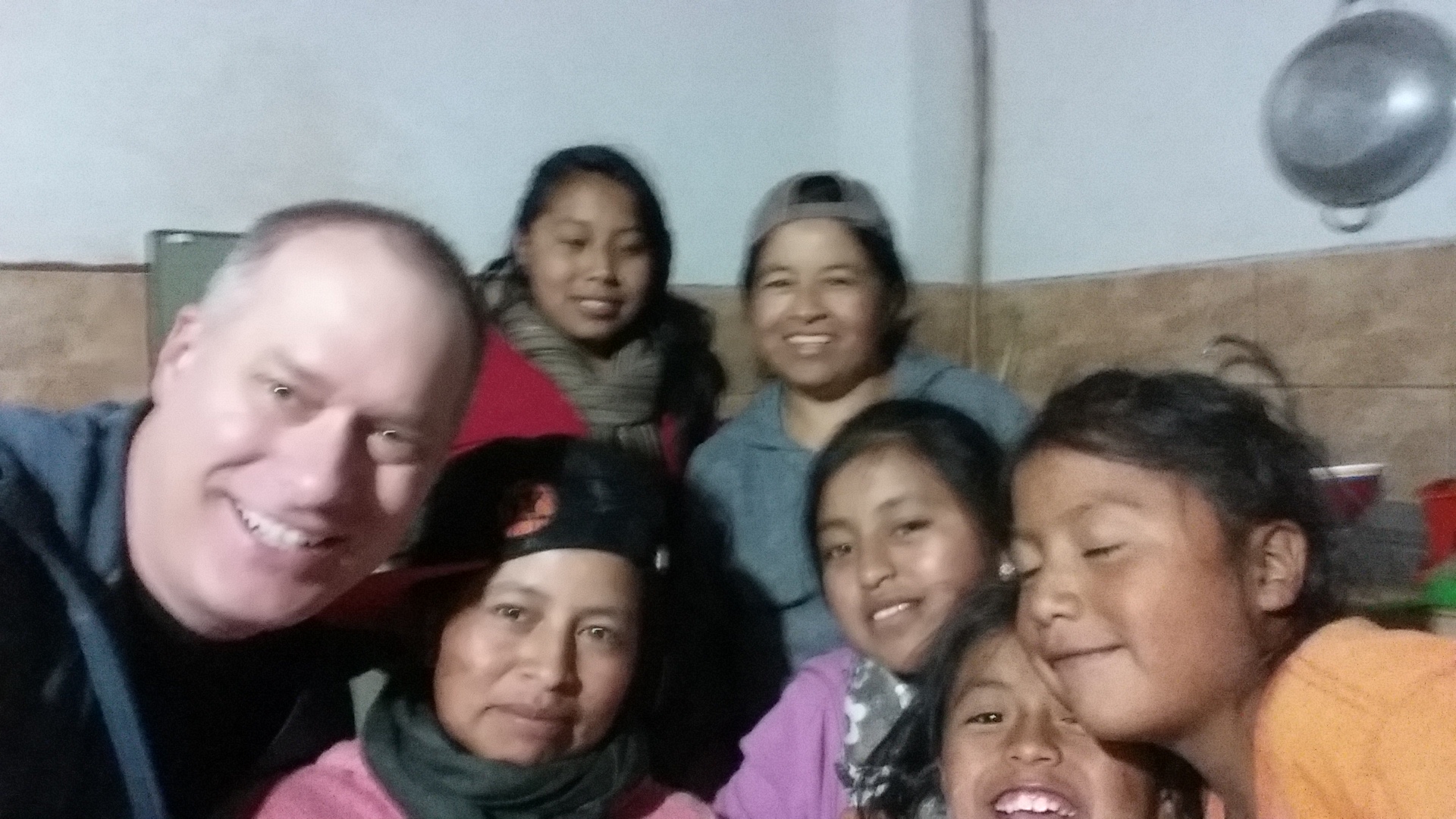
    MoralesKitchenAndMe
    Crazy bald-head gringo with the dinner party.

    My host family spoke spanish fluently but their primary language at home is Quechua. They told me that they often speak a combination of Quechua and Spanish; sort of like Spanglish.

    I started each day with breakfast at 8:30 am followed immediately by Spanish lessons beginning at 9:00 am sharp (my teacher was a stickler). These sessions consisted of a combination of conversation and various exercises. We took a 20 minute break at 11:00 am and then wrapped up at 1:00 pm for lunch. After lunch we headed out for some sort of day trip. The Spanish instructor was my guide so these short trips were continuations of my language lessons.

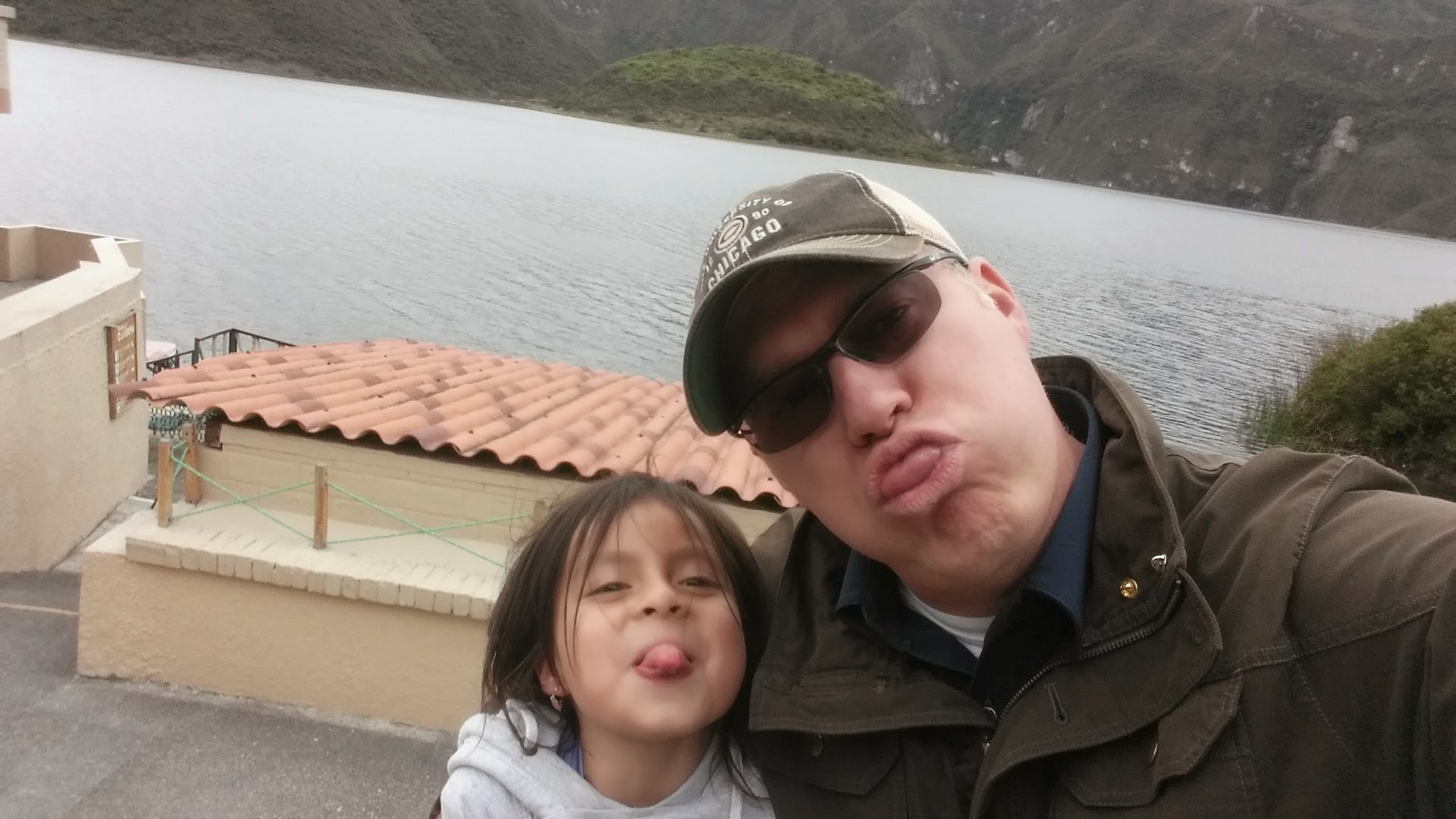
    One day we visited the city of Cotacachi, a popular destination for expats where we strolled past leather making shops, the town square and to a museum commemorating the city’s history as a center for great music composers. Another day we hiked to a beautiful waterfall where indigenous people once bathed in the cold falls as a spiritual cleansing ritual. Another day we visited a Crater Lake like water formation at the foot of one of the large volcanoes in the area. On this trip we were joined by another Spanish instructor and her young daughter.

    spanish-instructor
    My Spanish instructor, Isabel
    lake-daughter
    Daughter of another Spanish instructor who came along for the day trip. Obviously, she held me in very high esteem.

    The highlights of my time in Chilcapamba included my daily walks from the bus stop in Quiroga, the nearest town with modern services, where I would say goodbye to my instructor for the day and walk back to the house where I stayed. It was good exercise (mostly uphill), beautiful scenery and friendly people of all ages would stare and sometimes say hello to the strange gringo.

    The other highlight for me were evening meals when my host family would gather allowing me to see how they interacted with one another. Often extended family, many brothers, sisters, aunts, uncles and cousins living in the same community, would be invited to dinner making it a festive affair.

    I managed to forge a friendship of sorts with the youngest in the family, a six year old boy named Tupac. He became friendly after I allowed him to play Minecraft and other games my kids enjoy on my phone.

    Here’s Tupac playing music for me to practice for an upcoming school performance.

    I loved my time in Ecuador and especially in Chilcapamba. Hopefully I will be able to return in 2016 to continue exploring!

    chilcapamba

    The Chilcapamba Community is always looking for English instructors, especially those willing to stay for 6-12 months. This would be an incredible opportunity to learn Spanish and to experience life in Ecuador as part of an indigenous community. If you might be interested please send me a note or post a comment here and I will put you in touch with the right people.

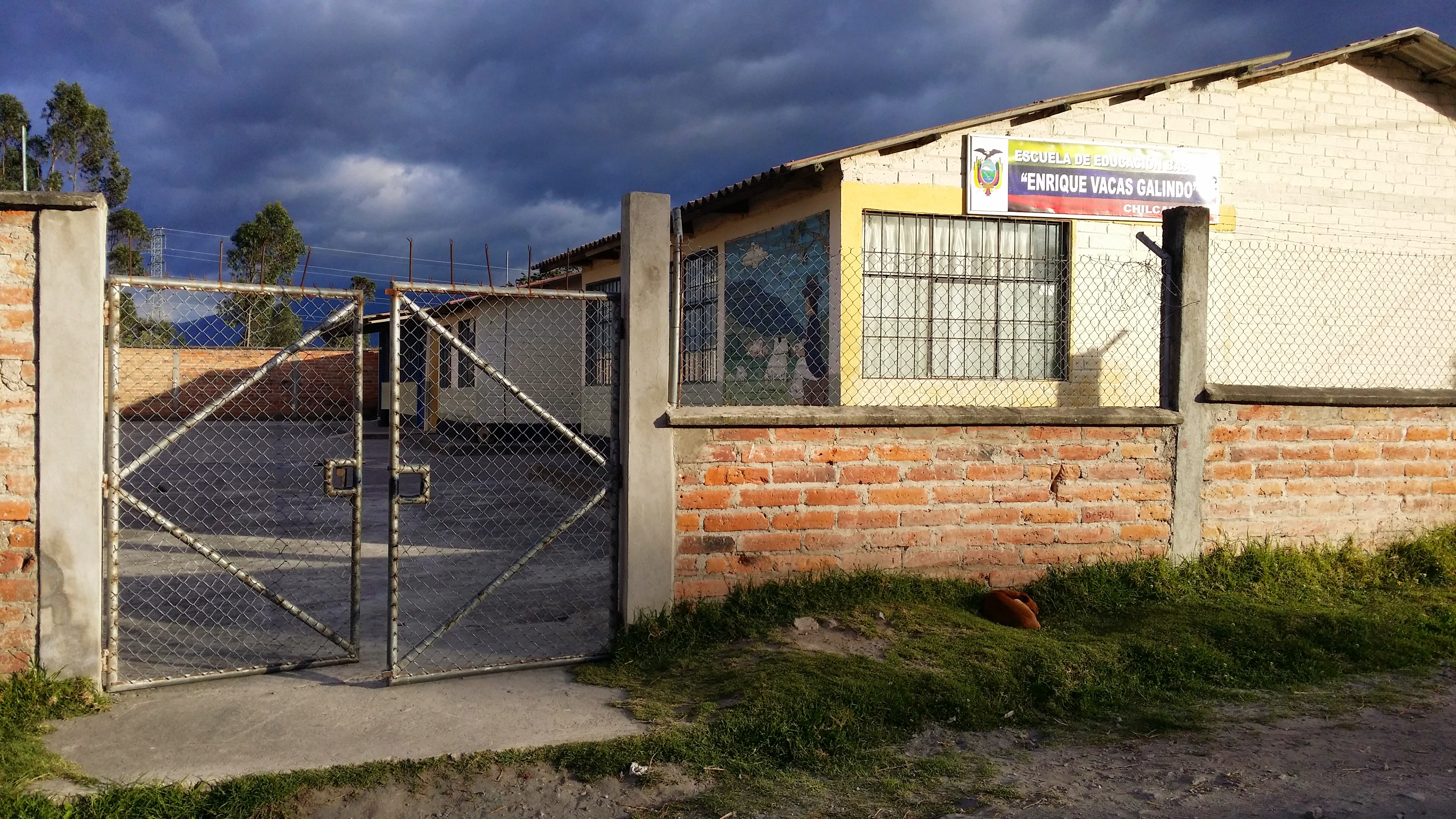
    chilcapamba-school
    Chilcapamba Community School
    chilcapamba-vista3
    View of Chilcapamba Community Church

    Adios y gracias por leer!


    Share:
    More
    • 11 years ago
    • Ecuador
    • Justin

    A View of the US from Ecuador: Shitty Food and Nowhere to Walk

    Before leaving Quito I had a chance to have a good conversation with the proprietors of the hotel where I stayed. It was so satisfying for me because the conversations were in Spanish and I was able to understand and make myself understood, mas o menos. Progress!

    [As an aside, this is a key advantage to staying in a small family-owned hotel. Yes, it will be less comfortable. But, it will also be less sterile. Not only will you save money you might also meet and learn from some real people.]

    During one such conversation I learned the hotel owners’ entire family, 15 people of various ages, recently traveled to the U.S. They flew into Miami and went on to Orlando to visit, of course, Disney World. They loved it! It was the trip of a lifetime for them. But, they were surprised that everywhere they went they found nothing but shitty food and no where to walk.

    This should surprise no one who lives in the U.S. I travel occasionally for business and it’s always a vacation from healthy living. Unless I’m staying in the center of a major city like New York, Chicago or San Francisco where public transportation is adequate, my hotel is typically on a concrete island devoid of fresh food. I might be able to walk to a next door restaurant or around the hotel where I’m staying but that’s about it unless I drive somewhere first. In contrast, most places I’ve traveled to outside the U.S., i.e., Europe, North Africa and various parts of Latin America, you can walk everywhere. Furthermore, it’s relatively easy to find fresh food.

    In Quito, for example, and here in Otavalo where I am now and where I stayed for 2 days last weekend, it’s difficult to walk more than half a block in any direction without seeing fresh produce for sale or without seeing a restaurant or cafe offering a decent meal with real food, i.e., unprocessed meat, vegetables, rice, etc., for a very reasonable price.

    When walking around Quito or Otavalo you’ll see on every block a small restaurant offering almuerzo. In Ecuador, almuerzo typically includes a bowl of hearty soup as the first course with maybe chicken and rice or potatoes, maybe corn and a few other vegetables. The second course typically includes a meat dish, often chicken, pork or fish along with a side of rice or beans and a small side salad. Then for the last course you’re often served a large glass of fresh fruit juice. Think smoothie or fresh squeezed juice but with an outrageous variety of delicious tropical flavors. So, you get a healthy variety of foods and it might cost $2 or $3. And, no tip required! Love that last part.

    In contrast, imagine landing in Orlando where many foreigners visit to take their children to Disney. Visitors from Latin America will probably stay in a hotel away from the Magic Kingdom where rooms are less expensive. If fortunate, they may be next to an IHOP or Ruby Tuesday or Outback Steakhouse or similar within a short walk, probably across a scenic parking lot. If unlucky, maybe only a McDonalds, Wendy’s, Carl’s Junior or a gas station style convenience market. Or perhaps nothing at all. This means paying ~$15 for some protein and carbs. Maybe a salad and an overcooked side vegetable. Or, it might mean paying ~$7 for junk food at a fast food restaurant. Or maybe $3 for Ho-Ho’s and a Coke. Furthermore, after consuming a dose of fat and sugar there’s nowhere to walk to burn calories. You can either risk life and limb to cross freeways and four lane boulevards or you can hop on the hotel treadmill and watch Bill O’reilly yell at people. Nice.

    The thing that occurs to me when I contemplate the nature of the typical American habitat as seen by foreigners is the US is increasingly at a competitive disadvantage in a global and mobile knowledge-based economy. Many careers with a future will require technology skills but permit mobility. I don’t think this bodes well for car-dependent communities in the US. And, people will only pay so much for the privilege of living in San Francisco or New York. If opportunities to earn a decent living as “mobile” work-from-home technology pros continue to grow while the cost of living differences persist between the US and Latin America, the outbound flow of relatively affluent and relatively young Americans could become a problem for the US economy.

    Furthermore, from a demographic standpoint we are an aging country with our largest age cohort entering or nearing retirement. Retirees don’t want to spend their days in traffic. And they are much more motivated to eat healthy food and maintain a healthy lifestyle. This means more walking and may lead retirees to look beyond the shores and borders of the US. This is already happening in fairly large numbers with retirees landing here in Ecuador and elsewhere in Latin America to take advantage of lower costs and, perhaps, a milder climate. As Latin America continues to develop modern infrastructure, especially health care and communication technology, this outbound migration of baby boomers, with money our US economy needs, will most likely accelerate.

    If both of these emerging outbound migration tendencies persist it could become a problem for the US economy. It might just begin to resemble that big sucking sound Ross Perot warned about 20+ years ago.


    Share:
    More
    • 11 years ago
    • Ecuador
    • Justin

    Adios Quito

    Yesterday I left Quito after a wonderful 6 day visit and now I’m in Otavalo, a market town about 2 hours north of Quito by bus.

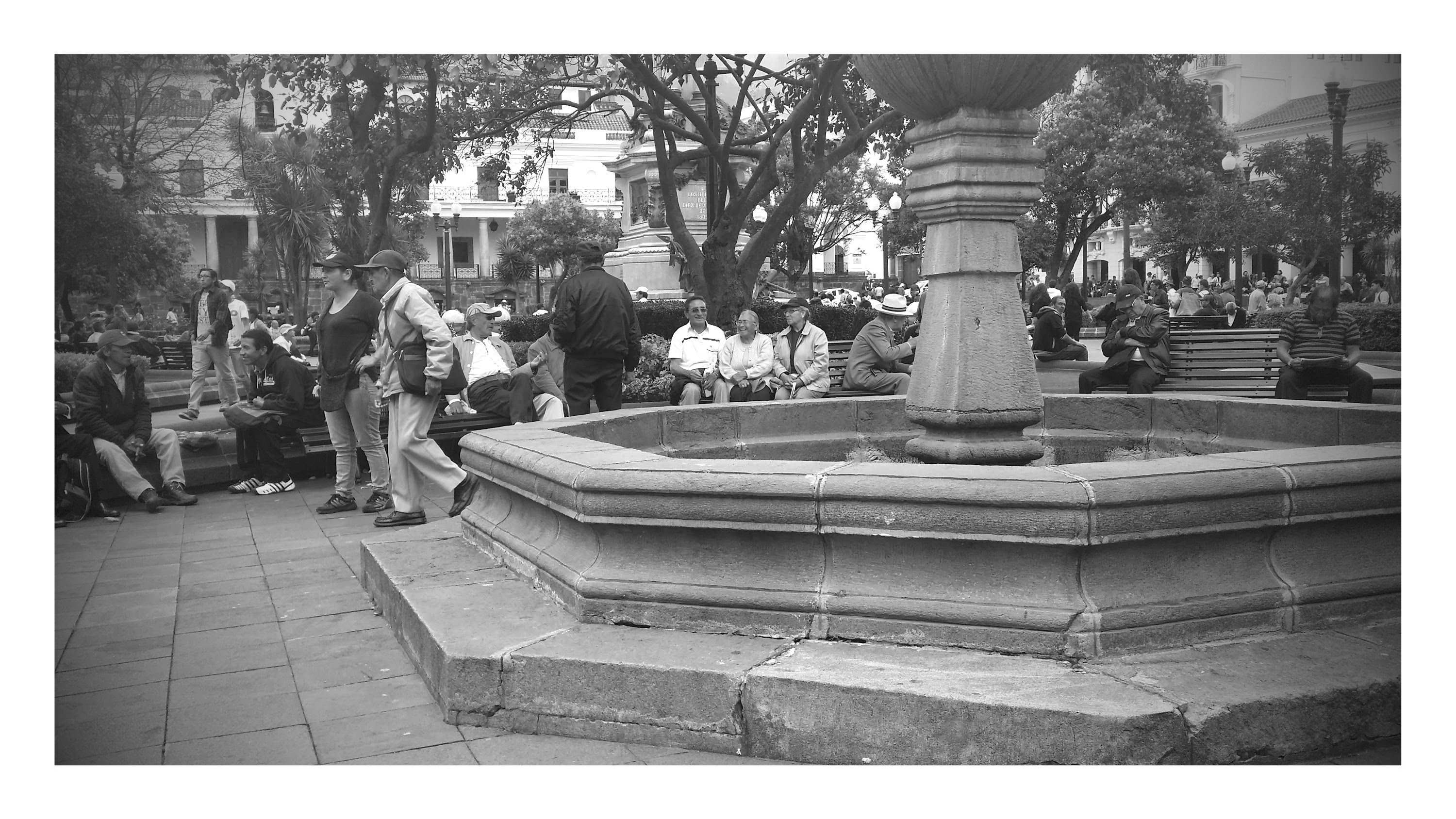
    My favorite activity in Quito (and in most cities) is people watching and one of the best places for people watching in Quito is La Plaza Grande in Old Town. Here’s a pic I took sitting in the Plaza. Just a typical weekday afternoon. I wish we had more central gathering places like this in the States. I could sit mesmerized all day if it weren’t for the cadre of young shoe-shine boys who will approach me every few minutes to point out how filthy my shoes look.

    20150504_134946-EFFECTS

    Even better people watching in Quito takes place walking the streets where small stores and people sell fresh fruit, sandwiches, ice cream and other sweet treats, lottery tickets, clothes, artwork, etc. I’ve seen a few old hombres crouching on the ground next to a scale, presumably offering the opportunity to weigh yourself for a nickel or two.

    One interesting tidbit: I have yet to see a single beggar in Quito. Signs of poverty are everywhere but I haven’t witnessed anyone asking for a handout. They are all trying to earn.

    Here’s a short video I took while walking down one of the bustling streets in Old Town Quito. Nothing remarkable. Just a quick slice of Quito. I’ve been reluctant to brandish my phone too much as I’ve been told to keep it out of sight to avoid putting a (larger) target on my back for thieves. I’ve also witnessed tourists offending locals by taking pictures without permission. I don’t want to be one of those tourists. The video is a bit jumpy I’m afraid.

    http://www.justinholman.com/wp-content/uploads/2015/05/OldTownQuitoWalking.mp4


    Indigenous people, mostly Quechua I’m told, blend into the city landscape in fairly sizable numbers selling fresh produce, roasted nuts and textiles of various sorts. The vendors are mostly older women and their assistants are typically young girls. Sometimes the women have babies on their back or toddlers by their side holding hands. I assume the men and boys are working elsewhere. I don’t know. I’d like to learn more about how the economy functions for these street vendors. Regardless, it’s fascinating to see indigenous people within an urban landscape dressed in traditional garments that don’t seem to have changed much since Pre-Conquistador times. Sometimes I have to pinch myself.

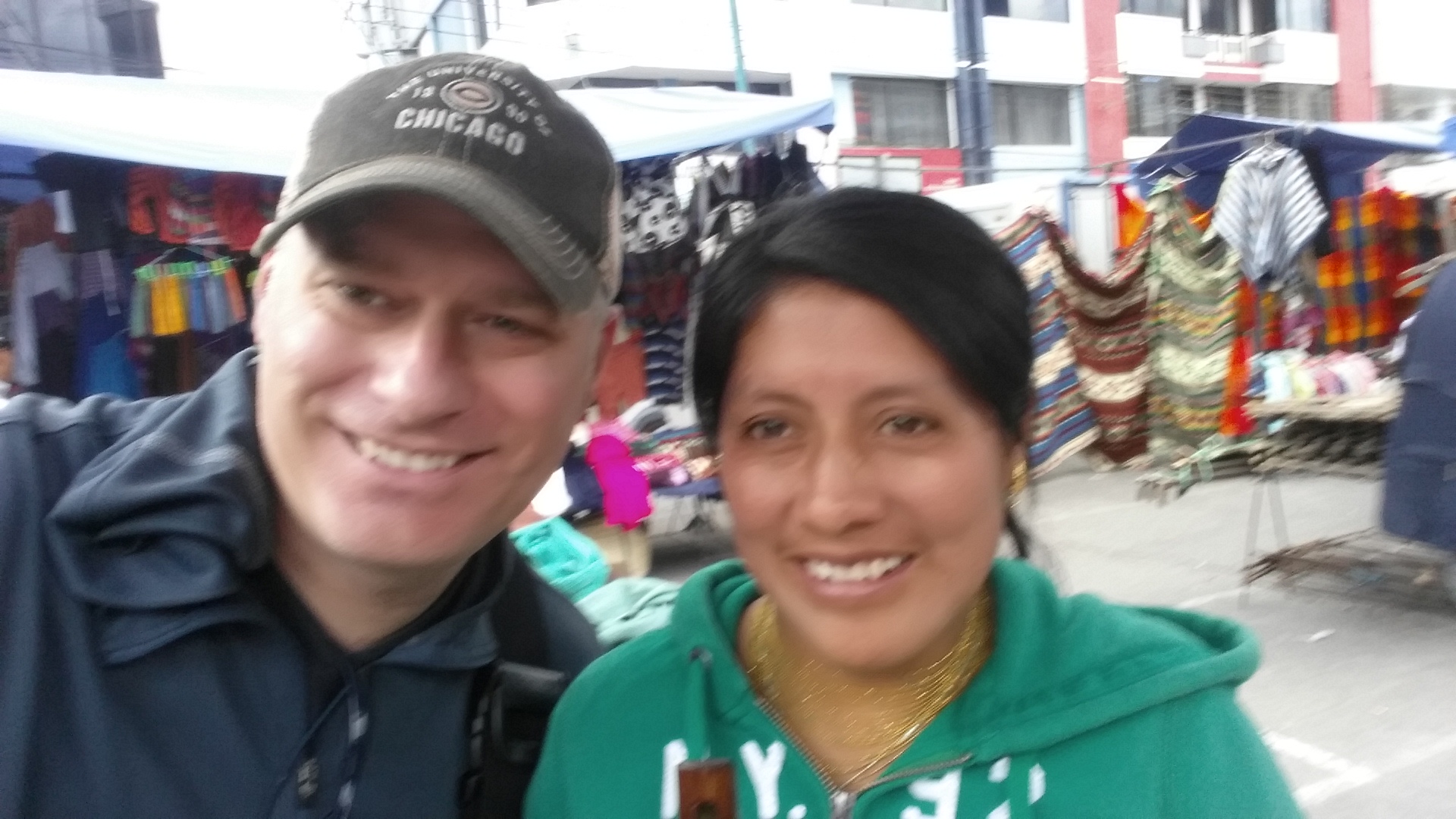
    In Otavalo the small city (pop. circa 90,000) is swarming with indigenous people who are in town to sell crafts at the market in Plaza de Ponchos. It’s a visual feast. Today I purchased a few gifts and convinced one of the vendors, my new friend Amelia, to take a picture with me as part of the deal.

    OtavaloMarket-Amelia

    Tomorrow I’ll be heading up into the nearby highland villages for a homestay with an indigenous family. Promises to be a fascinating experience!

    Hasta luego!


    Share:
    More
    • 11 years ago
    • Ecuador
    • Justin

    Why Ecuador: 10 Reasons to choose Ecuador for study, travel or retirement

    My wanderlust was reawakened this past spring while teaching a course entitled, “Geography of the World Economy” in the Hasan School of Business at CSU-Pueblo. I was like a kid in a candy store sorting through various materials to present to my students. I must have watched 30-40 videos, mostly documentaries with plenty of TED talks thrown in and a small handful of feature length movies from the historical fiction genre. I probably read a hundred articles, mostly in the Economist which may be the only periodical left in the entire world worthy of respect as a source of high quality journalism.

    In any case, I had to travel. But where?

    Everyone has their own tastes, requirements, limitations and parameters and I’m no different. Instead of describing my personal decision factors, I’ve tried to come up with good reasons for anyone to consider a trip to Ecuador.

    Here’s my list:

    1. Ecuador is in the Central Time Zone, same as Mexico and Central America. Every time I’ve traveled to Europe I’ve lost 2 or 3 days to jet lag. Didn’t lose a minute upon landing in Quito; certainly no more than on my recent trip to Chicago. They should call it time zone lag, not jet lag.
    2. The US Dollar is the national currency. Don’t underestimate how this reduces travel headaches in a multitude of important ways.
    3. Biodiversity. Where else can you find the Galapagos Islands, Amazon rain forest, Pacific coastline with gnarly surfing and whale watching, and the Andean Highlands complete with Cloud Forests (look it up, bird watchers paradise) and active Volcanoes; all this within an area approximately the size of Colorado?
    4. Cultural Diversity. There are 3 million indigenous peoples from 12+ distinct culture groups in the country. Remnants of the ancient Incan empire are all around. Hunter-gatherer tribes live traditional lifestyles completely isolated in the Amazon. Catholic churches built by Conquistadors and their descendants are numerous and Catholicism and other cultural legacies of Spanish colonization continue to thrive in contemporary Ecuador.
    5. Climate. Ecuador is, of course, on the equator but the climate is mild because much of the country is at a relatively high altitude. Quito is far more comfortable than Panama or Costa Rica, for example, where you’ll find hot temperatures most of the year. This goes for the Andes highlands where most urban areas are located; the western lowlands and eastern (Amazon) regions of Ecuador are a different story.
    6. Spanish. If you want to learn a foreign language, Spanish is the way to go … unless perhaps you’re willing to tackle Mandarin and travel across the Pacific regularly. Spanish is the second most spoken language in the world behind Mandarin and ahead of English. That’s right, gringo, ahead of English…and probably widening its lead as Latin America continues to grow at a rapid clip. For this reason, Brazil and Belize are right out!
    7. Safety. Although every specific city/town/neighborhood/location is unique, generally speaking Ecuador is safer and more stable politically than Mexico, almost all of Central America, Venezuela and Columbia. If you omit crime near the northern border with Colombia, it’s on par with the safest parts of South America, i.e., Chile and Argentina. But, it’s closer to the US with travel times to Quito far shorter than to Santiago or Buenos Aires. As an aside, for context, the 2014 murder rate in Ecuador was lower than the 2014 murder rate in the State of Louisiana. Maybe Bobby Jindal has a political future in Latin America?
    8. Sample some Socialism. The current President of Ecuador, Rafael Correa, is a self-proclaimed socialist and had a strong alliance with Hugo Chavez. He was elected in 2006 and re-elected twice since. Most citizens in the US have no fucking clue what socialism means. Come to Ecuador and you can check out a flavor of socialism first hand. I’m not saying let’s all be socialists. But why not learn something before dismissing it entirely? If you hate socialism but you’ve never experienced its application in a particular location, then you’re no wiser than my 6 year old who loves noodles and tomato sauce on pizza but refuses to try spaghetti with marinara sauce.
    9. Cost of Living. Ecuador es muy barato. A small but relatively upscale and modern apartment in downtown (La Mariscal) Quito will run you about $500 per month. If you’re willing to live among la gente you can find a place for less than $200 per month. A typical lunch (almuerzo) in Quito costs $2-3 and for that price you get a hearty bowl of soup, a rice or noodle or bean dish with meat, a small side salad and a large glass of fresh juice. For breakfast this morning I was in a bit of a hurry and bought two queso empanadas (sort of like a large cheese filled croissant). It was plenty to carry me to lunch and cost less than $1. Bananas cost about a nickel each. I plan to take a bus 2 hours north to Otavalo in a few days. A one way ticket will run me $2. I had a small load of laundry done today. It was neatly folded and smells fresh, all for $1.50. My biggest expenses on this trip are airfare and the $11 per hour I pay for Spanish language instruction. I could probably find instruction at a lower price but it wouldn’t be as good and it wouldn’t benefit a terrific non-profit organization. More on Yanapuma later.
    10. Southern Hemisphere Cred. After visiting Ecuador you’ll be able to say you’ve been south of the equator……uh, sorry, we live in a decimal based society and I didn’t want only 9 reasons in the title.

    That’s it! I hope this might be useful for anyone out there trying to decide on a location for international perspective, an ecological adventure or a new chapter in life.

    Segura viaja mis amigos!


    Share:
    More

    Posts pagination

    1 … 4 5 6 … 17

    Archives

    Popular Posts

    • Why Relocate to Pueblo Colorado
    • The 3 Lessons I Learned After Accidentally Buying a Liquor Store
    • 2014 Rankings - Top 10 Graduate GIS Programs
    • 2015 Rankings - Top Graduate Geography Programs for Spatial Careers
    • 2017 Geography Graduate Program Rankings

    Recent Posts

    • An Ode to My Students
    • Forecasting Confirmed COVID-19 Cases
    • Climate Anomalies and Aftermarket Part Sales
    • Weather and Climate Data for the Automotive Aftermarket
    • Technology Jobs in Pueblo

    Recent Comments

    • Joe on Lesson 2: World Regions and Theories of Uneven Economic Development
    • Justin on Pueblo Neighborhoods 1.0
    • Raj on The 3 Lessons I Learned After Accidentally Buying a Liquor Store
    • Maggie on Pueblo Neighborhoods 1.0
    • Justin on Pueblo Neighborhoods 1.0

    © Geographical Perspectives, 2017

    Site Managed by Gecko Designs

    Forget password?

    What are you looking for?